

What is Click & Collect and how do you get started with it?

Shopping online has become normal. Typically, a person will order goods in an online store, on a sales platform or directly from the retailer’s website. The desired items are then promptly delivered to one’s doorstep. With Click & Collect, things are a little different: orders are placed online, but the customer picks up the order at their preferred retail store or location.
We’ll discuss how Click & Collect works, what opportunities and challenges there are, and how retailers can integrate the concept into their own website or online retail shop.
Click & Collect: More in the demand than ever before during the pandemic
The coronavirus crisis has made it difficult for stationary retail stores to continue with business as normal. Few manage to compensate for the loss of sales due to recurring and long-term store closures during lockdown. The search for alternatives has become even more important. Those who have not yet dared to enter e-commerce, can now take the decisive step.
The positive response to Click & Collect shows that retailers don’t need to combine a stationary store with online support and extensive delivery options in order to be successful. If you offer your customers the option temporarily (and possibly long-term) to order online and pick up their items in person, you can increase your chances of staying in business even during pandemic-related lockdowns.
How does Click & Collect work?
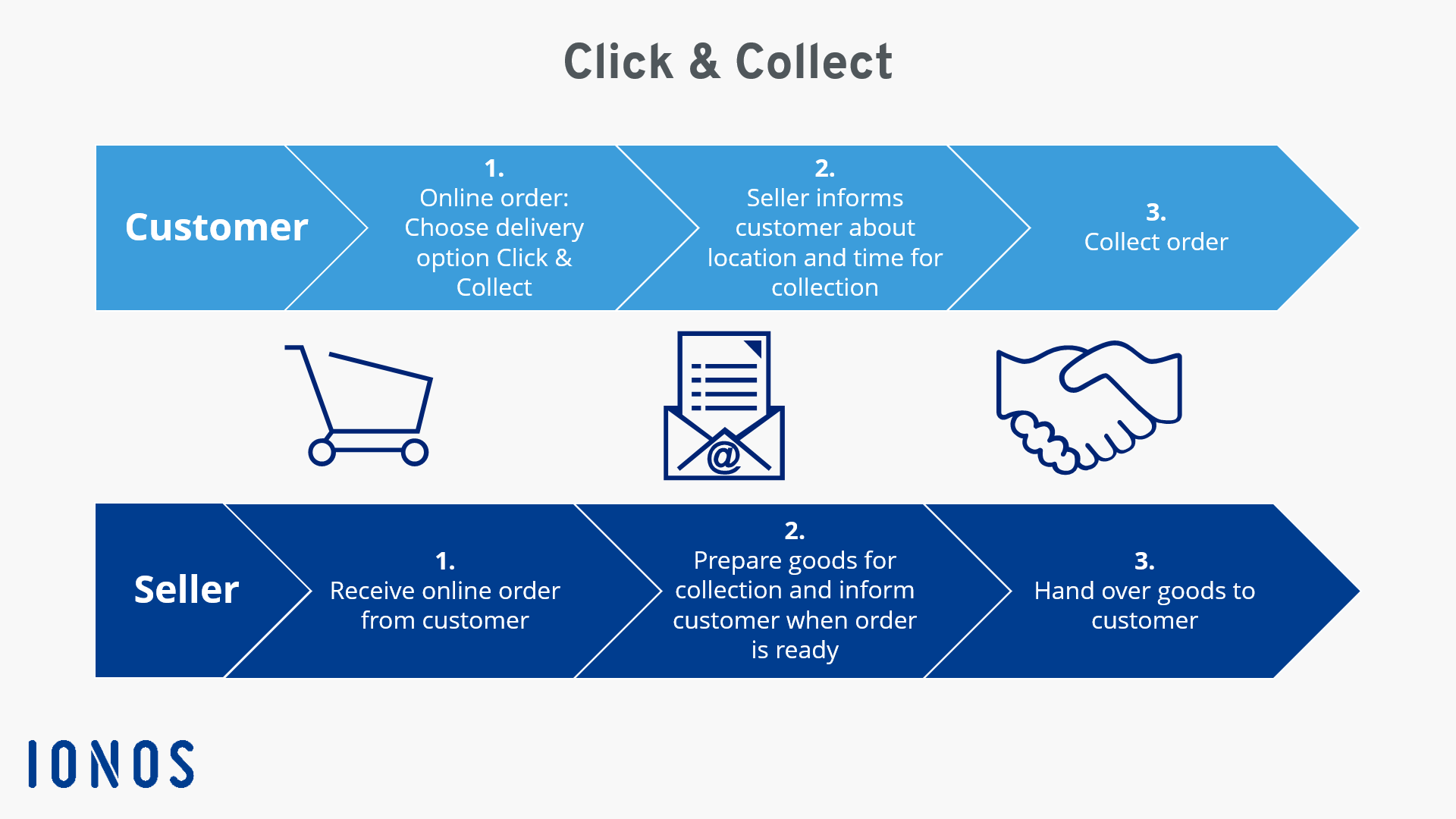
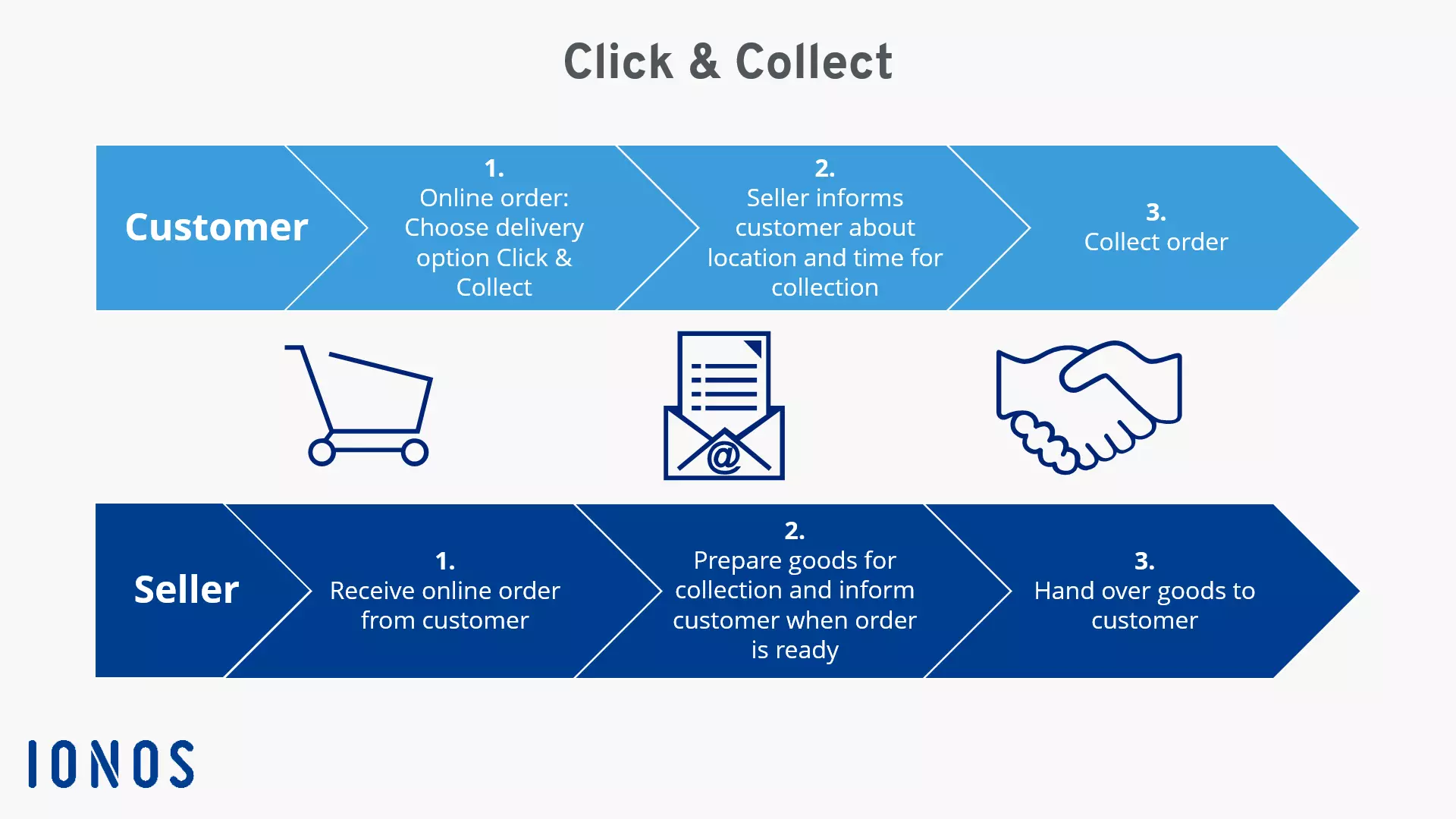
There’s no simple answer as to the best mode for a Click & Collect service. The way the service works will depend on the individual retailer and which specific implementations they’ve made. A fashion brand, for example, may include fitting on-site as part of their service, while a restaurant would not offer a free taster sample. There are generally three steps that are central to most Click & Collect services:
- A customer orders online and selects the option to “Collect” their order. They then pay for the goods through an online payment system.
- The seller confirms the sale and forwards all the details necessary for the collection. The goods are prepared to be collected. Once they’re ready to be collected, the seller informs the customer.
- The customer picks up the goods within an agreed time frame from the designated location. If the items have not yet been paid for, payment would occur on-site.
What are the advantages of Click & Collect compared to online orders?
A Click & Collect order differs from a standard online order mainly due to the last step: Instead of the typical delivery of goods through an external parcel or delivery service, the customers collect their items themselves. Depending on the type of product, the option has several advantages over traditional online purchases:
- Flexibility: Some people may not be at home to receive parcels. Click & Collect gives customers the option to choose a collection date that suits them. During normal business hours, items can usually be collected at various times of the day.
- No delivery costs: Home delivery is extremely convenient, but it also comes at a price. With a Click & Collect order there are no shipping costs, so you can make a nice saving here.
- Fast availability: As soon as the goods are packed, customers can pick them up on the same day or the next working day. In addition, customers are reassured that their goods are in stock.
- Additional services available: When handing over the goods on-site, the seller can provide the customer with additional services that are not possible with traditional online purchases. For example, trying on fashion items directly or testing the functionality of technical devices on-site is conceivable.
- Secure payment options: Even if paying online has become more secure in recent years, online payment processing is not for everyone. If the seller does not request payment in advance when placing the order, Click & Collect customers can use the usual means of payment such as cash on-site.
Click & Collect also provides an opportunity to push against the so-called ROPO effect. This describes the process in which customers first find out about a product on the web before purchasing it in brick-and-mortar stores. With a Click & Collect option, you can provide a middle ground, since the final deal takes place on-site.
Which challenges do Click & Collect sellers need to master?
Click & Collect can be a great opportunity for retailers and brands to pursue customers to make a purchase. As a mix between e-commerce and stationary sales, the model reaches a big target group.
For the self-collection service to become a business-promoting component of the corporate strategy, it must also be designed to be as attractive and simple as possible for customers – which is often easier said than done. Organizing a smooth Click & Collect sale poses challenges for small and medium-sized businesses, which are often overlooked during planning.
Warehouse management and availability
The management of the inventory is part of the standard procedure. If you want to offer Click & Collect, you need to be on your toes. On the one hand, it is important to always keep stock availability up to date; and on the other hand, orders for goods that are not stored on-site should be processed promptly if the purchase is a Click & Collect purchase. Unlike normal online orders, customers hope to gain quick access to the products they have purchased.
Clear and timely communication
When and where exactly can purchased goods be picked up? These questions need to be answered in detail immediately after purchase. If a time frame cannot be specified, it is sufficient to indicate that the customer will receive another notification as soon as the order is ready for collection. The seller should send these details as soon as possible.
Responsibility for Click & Collect orders on-site
There is a lot of work involved in everyday business. Anyone who takes care of incoming or canceled Click & Collect purchases and the preparation of goods will appreciate that being well organized is key. The same applies to responsibilities like customer service to solve questions and problems relating to collection.
Mark the pick-up area clearly
Anyone who ordered and paid for goods online and has chosen Click & Collect won’t want to search for hours to find the area to pick up their items. Before the information counter becomes the first point of contact for Click & Collect buyers, retailers should do everything in their power to mark the location for picking up online orders and describe the route to get there where possible.
During exceptional times such as the corona pandemic, special measures are required when picking up goods on-site (if allowed!). Sellers and buyers may need to wear a mask or stick to social distancing regulations. In case of doubt, you should convert existing collection areas to suit the situation. Windows or temporary outdoor pick-up areas are just two of the possible answers to the difficult conditions.
Avoid long queues during pick-up
Queues are one of the main criticisms for stationary sales. There’s little retailers can do to avoid queues which is why this is also a challenge for the Click & Collect model. But if you anticipate high demand – for example, during the holiday season – you could hire more staff to help and minimize waiting times.
Click & Collect: Opportunities and prerequisites
If you want to offer your customers the option to Click & Collect their items, you’ve got a series of different options, depending on your business category and type of goods. Here are some of the favorite types of Click & Collect.
Your website
A website is a useful investment for plenty of good reasons. You can use your web presence as a point of contact for Click & Collect sales without the need for any additional technical extras. You just need to add an order function if payment happens on-site. This is a low-cost and less laborious option to incorporate Click & Collect for smaller retailers and restaurants.
Online shop and e-commerce platform
If you operate a web shop, it’s often easy to active Click & Collect. Many available shop applications such as Shopify or WooCommerce, and many website builders and content management systems include functions that make it easy to integrate Click & Collect as part of the checkout process. If the option is not included in your standard installation, you can find extensions (e.g., plugins and add-ons, etc.) to help.
The MyWebsite builder from IONOS lets you design your dream website that includes a Click & Collect shop.
Checkout system
Some Point of Sale (POS) systems such as Shopify provide functions that can be activated to implement Click & Collect. If your shop system or your CMS or website builder does not offer support for your collection service, these systems are a good alternative.
Sales or order platform
From Amazon to DoorDash – large platforms to order a wide variety of products are a central element of the World Wide Web. If you plan to sell your goods on marketplaces like these, you can also offer your customers Click & Collect. In this case, however, sellers should consider that this may incur higher commission rates.
- Free Wildcard SSL for safer data transfers
- Free Domain Connect for easy DNS setup
Reviewer

Melissa Senn
Melissa Senn has been with IONOS since 2016 and focuses on the areas of websites, e-commerce, social media, and AI in the Digital Guide. As a digital strategist, she draws on her extensive SEO and GEO experience to translate complex technological trends into practical content.