

Writing a past due letter: samples for professional letters requesting payment

Outstanding claims – also known as outstanding debts – threaten the solvency of a company. The more unpaid customer accounts you have, the greater the liquidity problem. High rates of outstanding debts not only lead to significant interest losses, but if payments end up having to be compensated with loans, additional costs will be incurred. Companies therefore endeavor to collect outstanding payments for services rendered in a timely manner. This is usually done through an out of court dunning process, in which customers or business partners are informed of their default through a series of reminders. If out-of-court measures do not lead to the desired result, companies have the possibility of asserting claims for payment through a court order.
In this article, we will show you how to demand a settlement for outstanding bills in a professional manner. Correct procedure is of central importance during a dunning process. As a rule, the reminder letter is a prerequisite for further legal steps. In addition, judicial disputes can often be avoided by appearing commanding and stressing the importance of payment throughout the dunning procedure.
- Simple registration
- Premium TLDs at great prices
- 24/7 personal consultant included
- Free privacy protection for eligible domains
Successful past due letters: best practice
The aim of the reminder letter as a tool for managing receivables is to reduce the number of outstanding debts, and to avoid the loss of receivables. At the same time, a professional dunning system is also geared towards retaining customers. This should be reflected in the tonality, as well as the number of escalation levels, which we will outline here to demonstrate business obligations to partners involved.
The legal basis for out-of-court past due notices by companies, lawyers, and credit bureaus are found in the Fair Credit Reporting Act (FCRA) and the Fair Credit Billing Act (FCBA). The Federal Trade Commission (FTC) oversees the implementation of these regulations. Court order for payment is regulated differently depending on what state you are in – disputes are usually settled at state level through general jurisdiction state and county courts. However, federal district and regional courts retain exclusive jurisdiction over cases considered to be an aspect of federal law or when the issue concerns parties located in different states.
Central legal concepts within the framework of the dunning system are maturity and default.
Maturity
The prerequisite for a dunning procedure is a creditor/debtor relationship, pursuant to state or federal laws, which allow a creditor to demand payment from his debtor for goods or services rendered. This type of debt relationship usually comes about through a contract (e.g. a purchase agreement). The following applies in principle: Missed payments can only be claimed through the dunning system if a claim exists and it can be proven that the claim is due:
Max Musterman wants to pave his driveway, so he buys a ton of gravel and three pallets from the hardware store. A payment term of two weeks after the delivery date is set out in the purchase agreement. The DIY store delivers the supplies the next day, thus fulfilling their contractual obligation, and they now have the right to reimbursement of the purchase price. This results in a debt relationship between Max Musterman as a debtor, and the hardware store as a creditor.
If the debtor fails to provide the contractually agreed upon service until the due date (e.g. 14 days after delivery), then the creditor has the right to demand it.
The term ‘maturity’ refers to the point in time when a creditor is entitled to demand an outstanding payment from his debtor. The immediacy of the debtor’s obligation to provide payment is linked to the due date.
In the above example, the debtor automatically falls into arrears once the due date has arrived. Reaching this point is a prerequisite for a creditor to assert claims against the debtor on the basis of due payment.
Default
If a debtor is in default of payment, the creditor has a claim for damages (in the form of dunning charges) and interest. A prerequisite for this are circumstances which may cause delay. This is the case with non-payment, despite the due date and the reminder.
The past due reminder letter is used as a tool for debt management purposes to give debtors an extension.
In the above example, the debtor Max Musterman automatically falls into arrears because the terms of payment are specifically stated with a calendar date (14 days after delivery). It is not necessary for the hardware store to issue an additional reminder, as Max Musterman already has the time information in his purchasing agreement, however, it is best practise to issue a past due notification letter the day after the due date, 60 days past due date and 90 days past due date.
The legal timeframe within an invoice is required to be paid at the discretion of the contract between the debtor and the creditor. Should the debtor fail to pay by the specific date set out in the contract, the creditor may then begin the dunning procedure either themselves, or through a debt collection agency.
Past due letter: specifications
There is no federal law or legal requirement from the US federal government, or outlined in the Fair Debt Collection Act, that defines exactly how a legal reminder, or past due letter should be formulated. In fact, the debt collector can also contact the person in written form, verbally, or through conclusive behavior. However, the United States Code does reference the information a creditor must provide in their communication with the debtor:
Past due letters must contain the following:
- The amount of the debt.
- The name of the creditor to whom the debt is owed.
- A statement that if the consumer notifies the debt collector in writing within the thirty-day period that the debt, or any portion thereof is disputed, the debt collector will obtain verification of the debt of a copy of a judgement against the consumer and a copy of such verification or judgement will be mailed to the consumer by the debt collector.
- A statement that, upon the consumer’s written request within the third-day period, the debt collector will provide the consumer with the name and address of the original creditor, if different from the current creditor.
Due to its strong character, the past due letter is the most popular form of correspondence.
If a debtor denies having received the reminder, the burden of proof lies with the creditor. It is therefore always recommended to use the written form. In addition, it should be demonstrated that the debtor has received the warning. This can be done by commissioning a messenger to provide witness proof. In the case of an entry letter, the postal deliverer acts as a witness. Thus, absolute legal certainty can be provided by the bailiff.
The following then applies: A past due letter must be explicitly titled as such. Accordingly, even a particularly polite or humorous demand for payment fulfills the function of the reminder, provided it satisfies the above requirements. A polite professional tone is always recommended, as you do not want to tarnish your own reputation as a business through impolite or rude correspondence.
A copy of the invoice may be enclosed with a reminder. In practice, open invoices are sometimes listed directly in the letter of formal notice. This is particularly advisable if there is the possibility that the debtor has misplaced the invoice, or possibly never received it. A reminder of the payment terms and even a threat of legal consequences may be required to increase pressure on the debtors.
Dunning procedure
In the USA, it is standard practice to send three reminders (past due letters) in commercial debt cases. There are slight differences between the first, second, and third letters. Generally, this dunning procedure is applied even if the debtor has already fallen into arrears, and could technically be brought to court immediately. The reason for this is customer retention.
Avoid sending more than three past due letters, as you may risk your concerns not being taken seriously since no further consequences seem to be feared by the debtor.
It is not always the case that outstanding payments are due to the unwillingness of the debtor to pay. In some cases, recipients have forgotten about the debt and settle the outstanding amounts. In other cases, the invoice may not have been received by the recipient of the invoice. In order to avoid unnecessary annoyance by defaulting clients, it is advisable to first remind them of their obligation to pay.
You may refer to the IONOS templates when creating reminders and due payment letters.
Past due letters: templates for the first, second and third letters
Use professional past due letter templates when dealing with defaulting clients. IONOS provides a pre-formulated sample letter for the first, second and third reminders as a Word file, or in Excel format.
Templates for the first past due letter/payment reminder
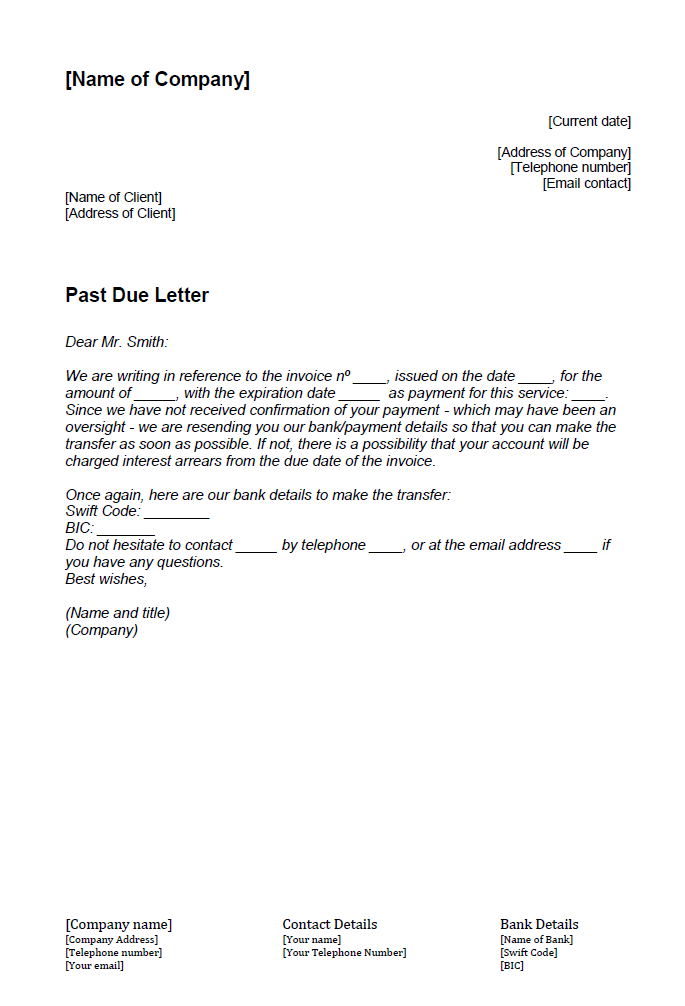
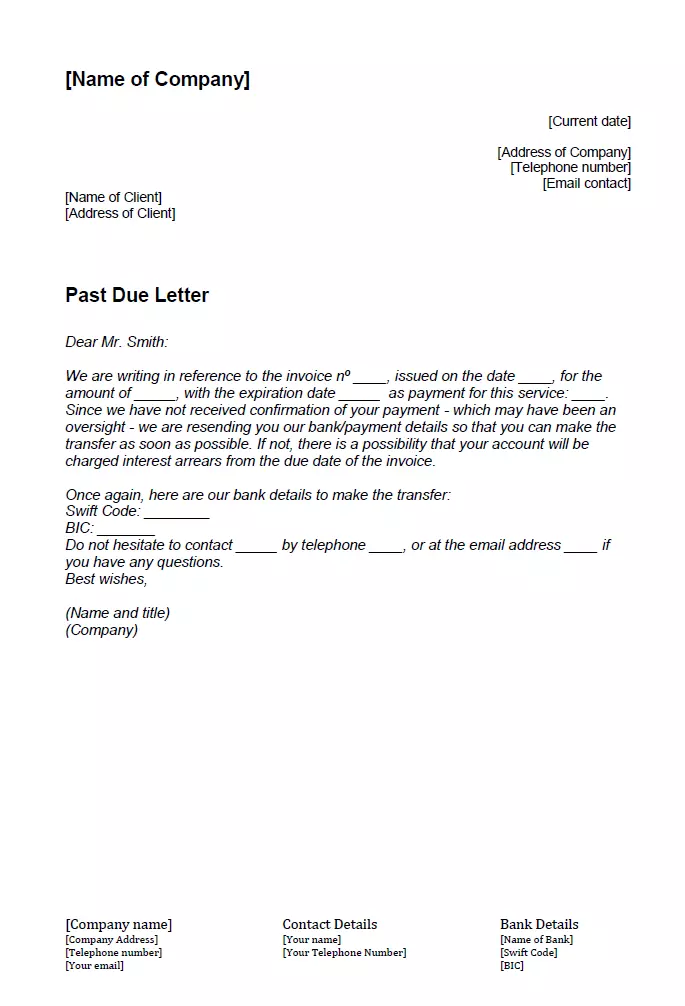
The first reminder should be made immediately if you find that an invoice amount has not been paid despite the due date having passed. If you have no reason to doubt that the debtor will pay his debt, or if you have no knowledge of bad credit from this debtor, then the first reminder should be written in polite terms. Express in a friendly, yet unequivocal manner, that you demand the due payment.
Here is a sample of what the body of the letter could look like:
Depending on the severity of the delay and the debt incurred, stronger language may be recommended when wording your letter before action.
Second past due letter: Template for the second reminder
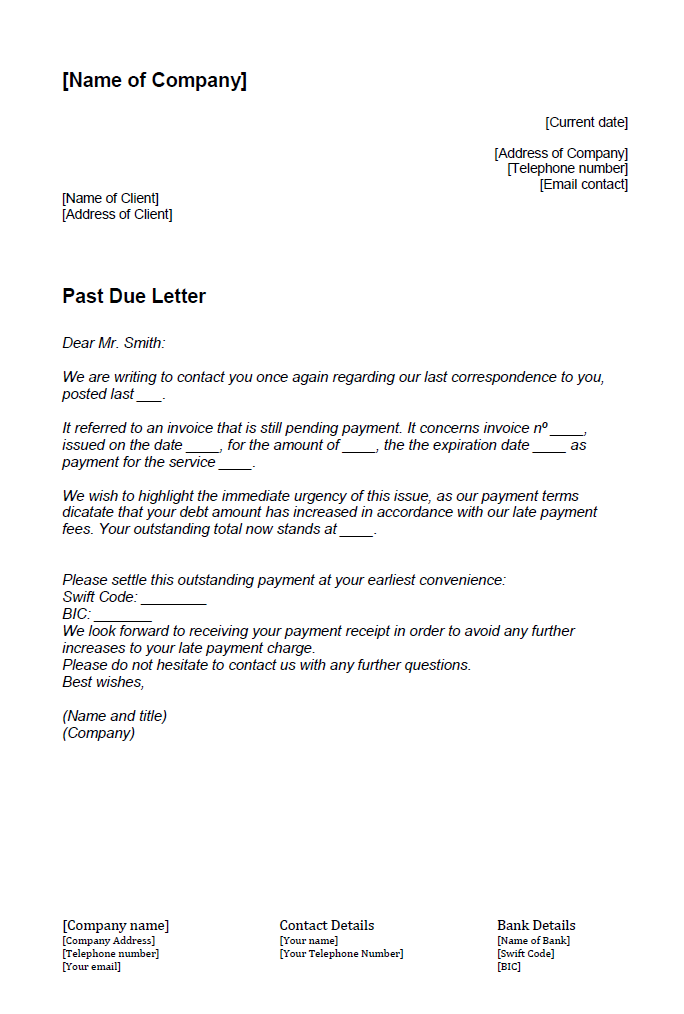
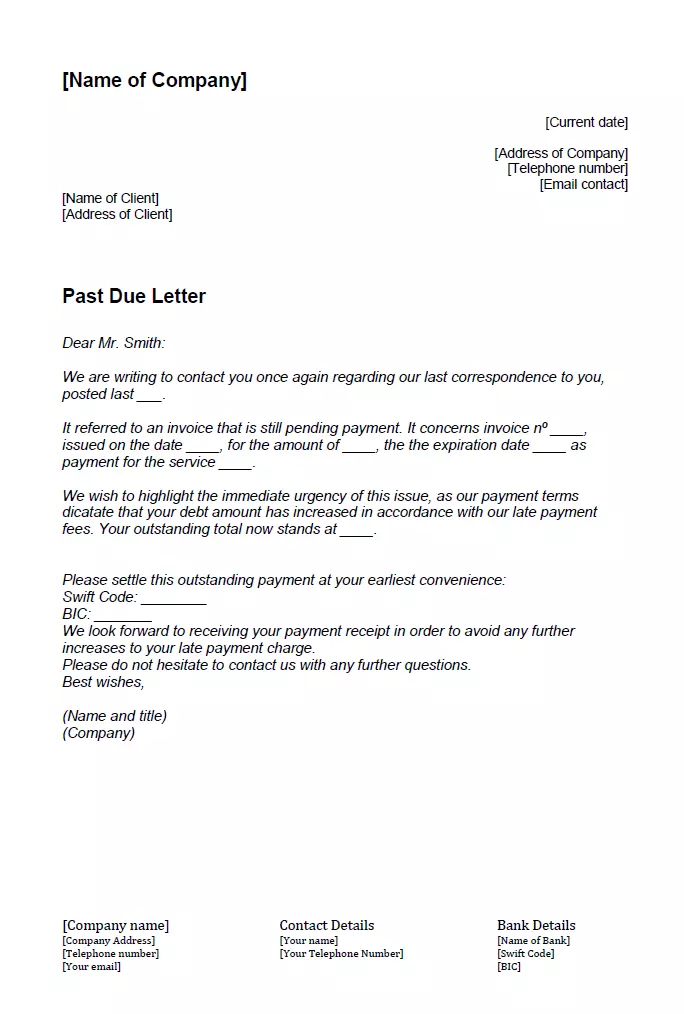
If the invoice is still not settled after 30 days of receiving your first reminder, it is advisable to send the debtor a second warning letter. This is usually explicitly titled with ‘reminder’ and written in a more serious, unmistakable tone. It is also advisable to provide another type of payment plan in the second warning letter:
Third past due letter: template for the last reminder
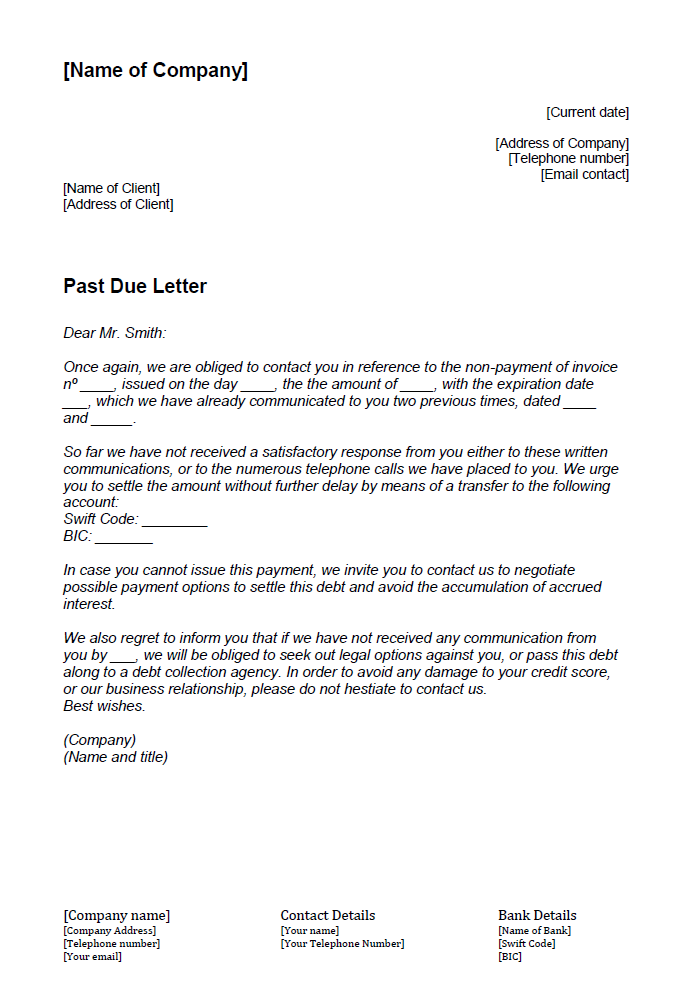
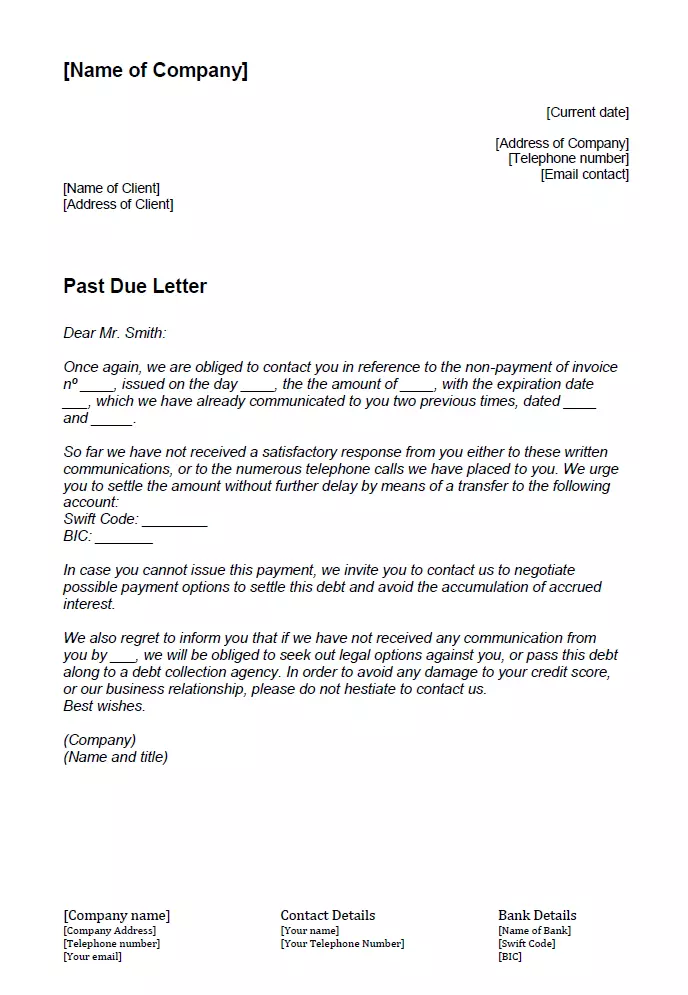
If a debtor remains inactive despite two reminders, send the third and last reminder. In this, highlight again the open invoice amount and establish a final payment date. Additionally, you should state in the third reminder that if you do not pay by the payment date, further legal actions will be taken to assert your claims. This pay include the involvement of a lawyer or the transfer of a claim to a collection office.
Avoid numbering the reminder letters, as a payment reminder titled with ‘1st’ will give the impression that you are quite willing to disclose further reminders. This could lead defaulting debtors to await the receipt of further letters before the invoice is settled.
How to use the past due templates from IONOS
With the IONOS templates, you can create professional payment reminders for the usual three step escalation. Proceed as follows:
- Download the template: All templates are available as Word or Excel files.
a. File format: Select the appropriate template in the desired file format.
b. Download: Click on the download link below the thumbnail for the template. - Replace all placeholders with individual data: All the templates contain text (e.g. address fields) that act as placeholders. These samples statements are designed to help you understand the use of the template and ensure that your reminder contains all the important information. Go through the document field-for-field and replace the placeholders in the following friends with individual data.
a. Header text: Each past due letter template contains a header area. This contains, in addition to the name of your company, the address of the customer to be advertised, as well as your sender’s address. Replace the placeholders with your individual details.
b. Date: Make sure that your reminder is marked with the current date.
c. Invoice number: Replace the sample invoice number with the number of the invoice to which your reminder refers.
d. Invoice date: Replace the sample date with the date of the invoice that was not paid.
e. Customer number: Enter under ‘Customer No.’ the number of the defaulting customer.
f. Reminder text: Depending on the template, the pre-formulated dunning texts contain data and accounting amounts. Instead, insert your individual details.
g. Invoice: The third reminder contains an invoice in which the open invoice amount is added up with the default interest and the dunning costs incurred up to that point. Transfer your individual details and determine the total amount due.
h. Greetings: Replace the greetings form with the preferred phrase. It is recommended to repeat the name of the signer in type-written form.
i. Footnote: The footnote of a formal notice letter should include the complete address of your company, your VAT identification number, and the bank details to which the payment should be made (or details on any alternative payment methods you may wish to offer). Make sure that you completely overwrite the template’s placeholders with your individual data. - Save and print the template: Print out and send the template to the defaulting customer. Always keep a copy of the reminder for your records. This can be done electronically by storing the Word or Excel document in a designated file folder on your system. Alternatively, print out another copy and keep the paper copy in your record books.
Unsuccessful past due letter: what now?
If the out-of-court dunning procedure does not lead to the desired result, a creditor can obtain legal assistance by taking the case to the small claims court (if the amount is under the state limit), obtaining legal services about how to proceed if the sum is above the state limit, or selling the debt on to a debt collection agency.
Click here for important legal disclaimers.