

What is the dark web?

Maximum anonymity and special access restrictions – these are the features that characterize the dark web. The hidden sphere of the world wide web is synonymous with criminal activity. But what exactly does the term “dark web” mean, what dangers lurk, and how do you gain access to it in the first place?
- Free Wildcard SSL for safer data transfers
- Free Domain Connect for easy DNS setup
Dark web: a brief definition
The term “dark web” describes a part of the world wide web that cannot be accessed via search engines such as Google. Instead, a special browser is required to access websites with .onion domain extensions. Basically, the term “dark” refers only to the fact that it is an access-restricted virtual space. However, since this is often used by criminals, the dark web is always associated with forbidden activities and dark machinations.
Accessing the dark web and associated technologies is not punishable by law or illegal. However, if you visit marketplaces and forums for arms trading, drug dealing, or similar illegal activities, and enter into a trade with sellers, you are committing a criminal offense. As a general rule, the dark web is not intended for the average Internet user to browse the web.
Dark web vs. deep web vs. Internet
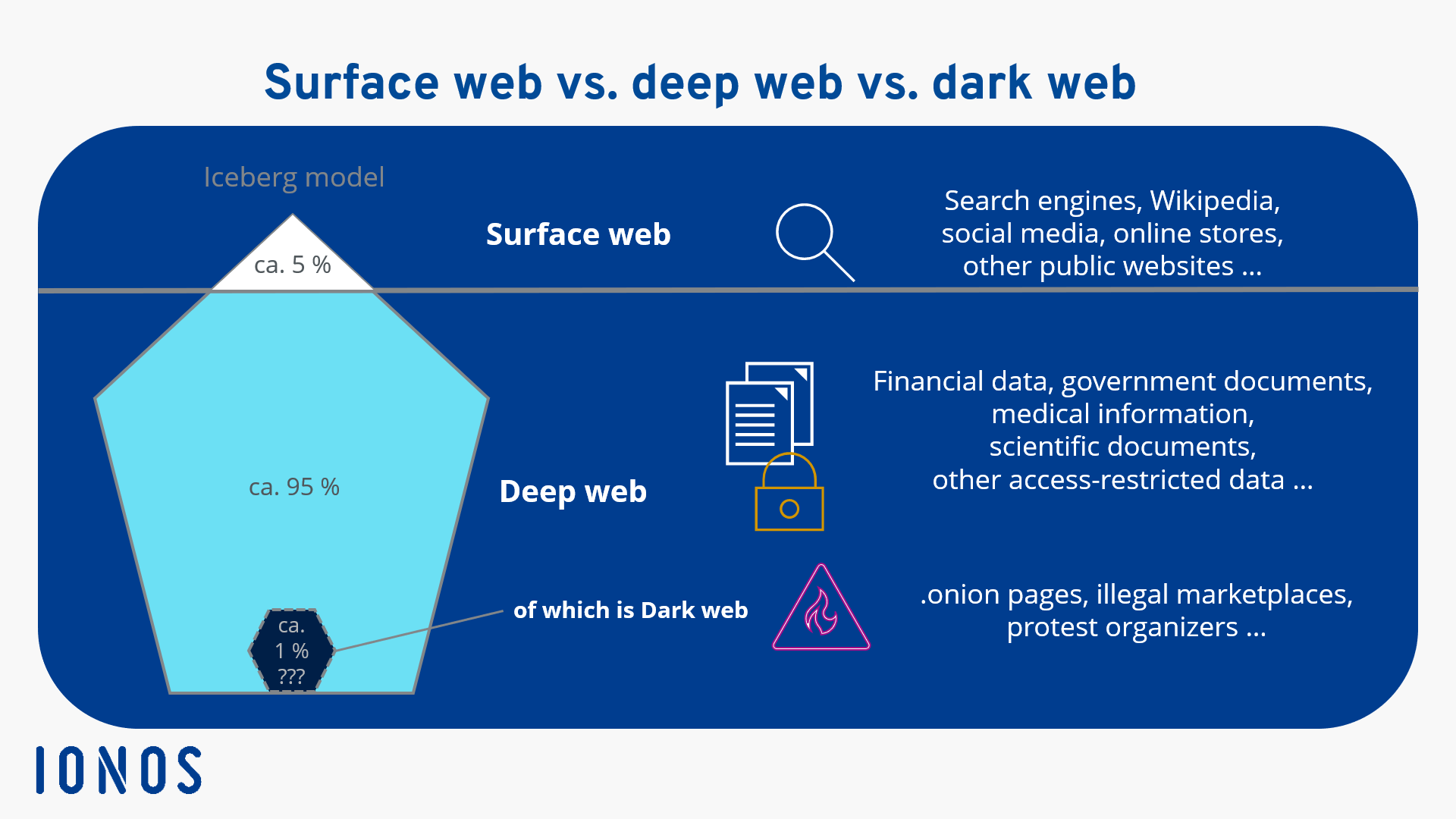
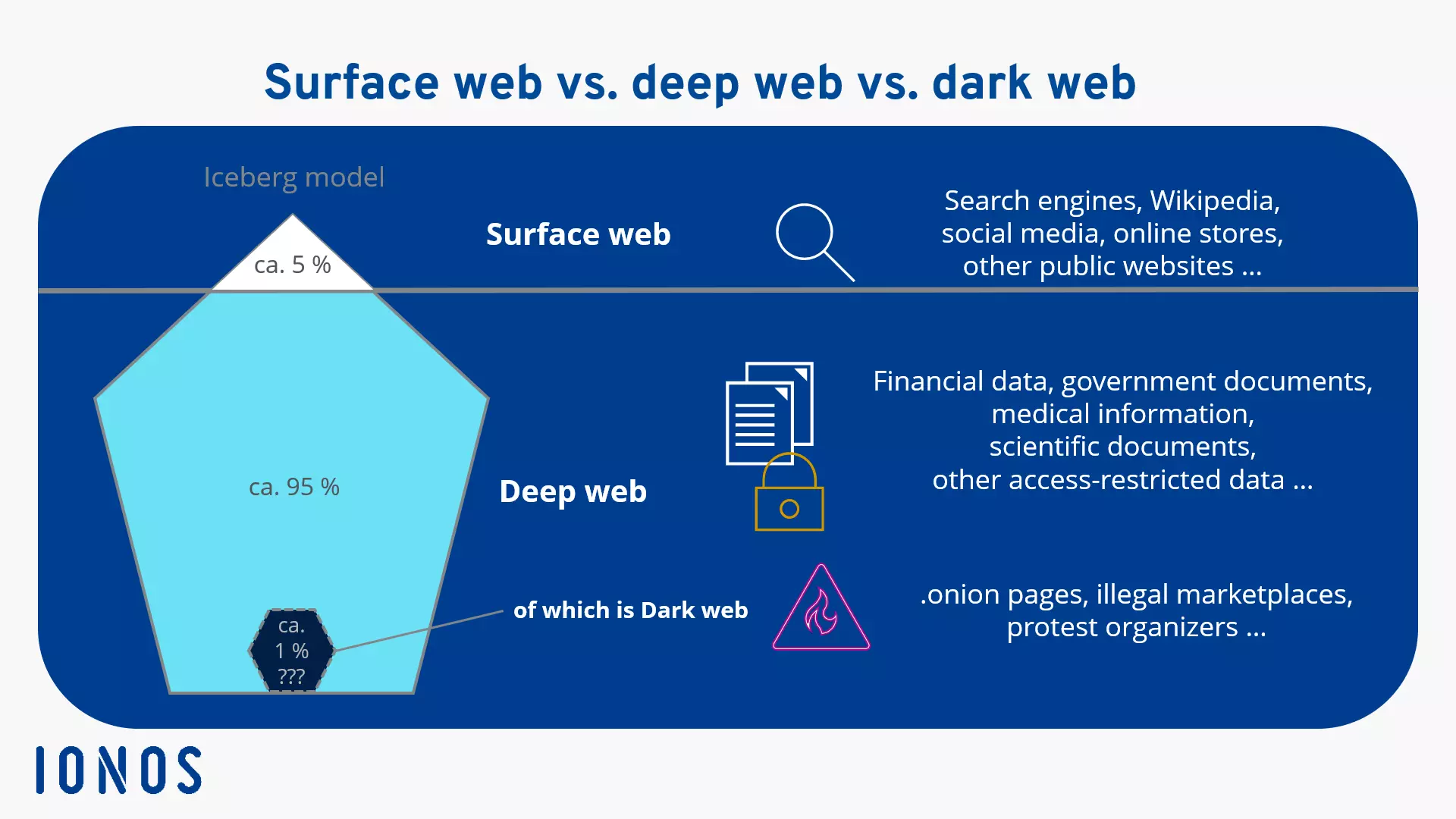
Strictly speaking, the distinctions between dark and deep web and the Internet are thin, because both the dark web and the deep web form part of the Internet. Here, the general browser-accessible Internet is thus correctly referred to as surface web or visible web.
Content on the surface web is accessible to everyone through search engines. Only about 5 percent of web content belongs to this category – some estimates put this percentage even lower. The deep web refers to all the content that is not freely accessible to everyone but, for example, requires a password in order to be accessed – bank accounts, medical information, but also member areas in online stores belong to this category. Search engines do not index this content. The restrictions to access dark web content are even stricter – special browsers are required.
What is the dark web for?
Characteristic of the dark web, apart from restricted access, is maximum user anonymity. Pages you look at or whom you communicate with remain hidden. Even payment transactions can be anonymous with cryptocurrencies such as bitcoins.
In general, it is possible to access legal web offers via the dark web, provided that a corresponding .onion variant has been created for this purpose. You can read more about .onion below. For example, in countries where social media pages such as Twitter or Facebook are censored, users could access these pages via the dark web. Journalists, opponents of political systems and whistleblowers also use the anonymity to disseminate information. In other words, the dark web provides plenty of room for “positive” activity.
However, in reality, there’s a lot of illegal activity occurring on the dark web. The trade in stolen data and drugs on marketplaces and forums is one of the more harmless processes happening on the dark web. Serious criminal offences, arms trafficking, and human trafficking take place on the dark web.
The dark web is not a lawless space. Police and governments are aware of its existence and access possibilities. However, law enforcement is an extremely complex undertaking in this respect, so that only the biggest deals are prosecuted and punished.
How do you access the dark web?
Access to the dark web is usually via a Tor browser, which can be downloaded just like Google, for example, but it works differently. “Tor” is an abbreviation for “The Onion Router”. This name provides a good description of how the underlying Tor network works.
Unlike traditional browsing on the visible web, user requests are not passed directly to the target site’s server and sent back. Instead, several superimposed networks or layers (similar to those of an onion) are used. A random path is chosen for the transmission of data via the various layers and nodes, the information is distributed across several routes and is not reassembled into a complete image or website until it reaches the recipient.
The individual connections between the nodes are encrypted and change constantly. Tracking the data and identifying the sender and receiver is more difficult. A noticeable result of this transmission process is that it takes significantly longer for a page to load fully. Users with higher security needs often combine the Tor browser with a VPN tunnel.
However, using a Tor browser alone does not mean that you are surfing the dark web. You are using the dark web when you are surfing on a domain ending in .onion. Pages ending in .onion cannot be indexed by Google or other traditional search engines. To access a page on the dark web, you either need to know its HTML, or use the (often incomplete) search engines and directories for .onion pages.
How dangerous is the dark web?
For regular Internet users, the dark web is rarely worth a visit. Although it has potential for meaningful activity and provides maximum anonymity, it is still a space where criminals tend to gather. Most people probably can’t even begin to imagine what kind of business goes on there. If you are toying with the idea of using a Tor browser because of its anonymity, a VPN client is the better alternative. It serves a similar purpose and maintains web security.
Reviewer

Melissa Senn
Melissa Senn has been with IONOS since 2016 and focuses on the areas of websites, e-commerce, social media, and AI in the Digital Guide. As a digital strategist, she draws on her extensive SEO and GEO experience to translate complex technological trends into practical content.