

How to take minutes: What needs to be considered?

Whether it’s a board meeting, legal consultation, or an association meeting, taking the minutes is often obligatory. However, it is an unpopular task and few are ever envious of the minute taker. Many managers even wonder why it’s necessary to record minutes. The answer is simple: the minutes are extremely important for all parties involved.
Why should you write and record minutes of a meeting?
Many people have to write numerous emails and documents every day, especially in office jobs. If they also have to take minutes, many will be reluctant and may ask themselves: “What is all this effort for?” You don’t have to think long and hard for an answer from now on, because there are many good reasons for taking minutes.
However, in order for the minutes to actually fulfil their functions, it shouldn’t just be a matter of writing them. After all, a well-structured, informative record is of no use to anyone if it ends up directly in the trash once sent out to the email distribution list. Only when employees and management actively use the transcript as a working tool does it have a positive effect. A simple way to ensure this is to have someone read out the minutes of the previous meeting at each meeting in order to recall the contents.
Understanding the minutes as a memory aid
In meetings, many decisions are made. However, if a meeting lasts a long time and there are numerous requests to speak, few people remember the exact working of the decision after a few weeks. It can also be hard to remember how these decisions were arrived at. Therefore, if you want to take up a particular issue in a subsequent sitting, it is extremely useful to be able to refresh your memory by reading out the minutes from the previous meeting.
To ensure that the participants’ contributions have been correctly presented, it is common practice to have the minutes checked by the session leader, and, in some cases, by all participants before being published.
Said things become a reality
Did a committee member commit themselves to a task and are now denying it? Do several people incorrectly consider themselves responsible for a certain area? A conscientiously kept record notes the distribution of tasks and therefore creates commitment.
Information can be accessed by others later
Whether due to vacation or illness, it can sometimes happen that employees are unable to attend a meeting. A well-kept record of the minutes keeps them up to date on what went on in their absence. Investors also have a right to information. If a share purchaser audits your company, the analysis team may ask for board meeting minutes or minutes for other important meetings.
What kinds of minute-taking procedures are there?
There are three main characteristics according to which different types of minutes can be distinguished:
- Time of writing
- Content focus
- The medium
Differentiation according to time
Minutes represent the sequence of a session, negotiation, or meeting. Depending on the time when the minutes are taken they can be assigned to a particular minute-taking type.
The apriori method prescribes the rules and the concept for an event. It is therefore written before the event. This type of protocol is often used in the field of diplomacy: heads of state follow a protocol to structure a formal event and avoid diplomatic incidents.
The now-method takes place, as the name suggests, during the session itself. Business meetings, court cases and scientific experiments often require this type of minute taking. This is because the events should be reproduced as accurately as possible. In the economic field, it is the most common form of transcript.
The aposteriori method (memory method) has the minutes recorded from memory after the session. This type of recording is helpful in order to be able to remember facts later that can have a potentially detrimental effect. It is used after traffic accidents and the subsequent discussion with the police or insurance company, as well as after verbal agreements with business partners. The aposteriori method is usually a kind of memory aid and does not require any particular form.
Focusing on content
If you want to take minutes, you first need to make yourself aware of why they need to be taken in the first place. You then take this purpose into account when designing the minute’s content:
If what has been said needs to be as clear as possible, use a verbatim report. With direct quotations in the person’s exact words, this method makes it possible to understand how certain decisions were made. The courts use this kind of protocol, for example, as evidence during negotiations. The following minutes must be clearly distinguished from the verbatim minutes, in which the person taking the minutes reproduces the content or events in their own words:
The flow trace shows the events in chronological order. Log a project by recording the duration of individual sections and the exact time that events took place. The progress log is a special form of minute taking that leaves room for more detailed records. Not only do you describe the chronological sequence, but you also record who made which statements and when. Depending on how detailed the minutes should be, you can also discuss the reasons for debates and their results in the progress minutes. Progress reports are common at team meetings or board meetings as well as at legal consultations. They are usually written in the present tense and contain indirect speech.
The result method is also well suited for meetings. Instead of the course, however, the results are presented here in detail. It is not just a matter of presenting everything that has been said during the meeting, but recording the minutes in terms of decisions. They therefore present the event in a condensed form and concentrate on those aspects that contributed to finding the results.
The seminar method (or teaching method) combines the result and progress methods. You assign the statements to different subject areas. You do not have to follow a chronological order. For example, if something is said about the first topic later in a meeting, enter it in that topic as well.
Recording media
Minutes can be differentiated according to the type of recording used. If you write a log, you can use either long or short hand, for example. If the document is to be used by other employees at a later date, a transcript in longhand is preferable. However, shorthand is excellent for note-taking. Minute taking of legally relevant meetings, however, is increasingly being taken over by machines. In computer technology, logging methods register your minutes and in the event of an accident, black boxes log relevant information. Sound recordings and video recordings are also possible.
How do you take minutes?
In the business environment, flow methods and result methods records are the most common forms. The minute takers usually transmit the minutes as a written document in electronic form. The advantage of this is that they save paper. The disadvantage of this is that colleagues easily overlook or ignore the document in daily email correspondence. Try to counteract this by making it easy for your readers:
- Formulate sentences that are as short as possible
- Make yourself clear and succinct
- Highlight important points with formatting
- Structure the log in a meaningful way. If points are further apart chronologically but belong together thematically, group them in the same section when taking the minutes. In a progress log, on the other hand, references to past or future events are not lost.
- The result of this is that you must consistently adhere to the chosen minutes’ format.
- Assign statements to the respective speakers.
- Attach the relevant documents at the end and link them to the appropriate place.
Thanks to its wide range of programs, Microsoft 365 is guaranteed to lighten your workload. Get the package that best suits your needs now from IONOS!
The structure of a protocol
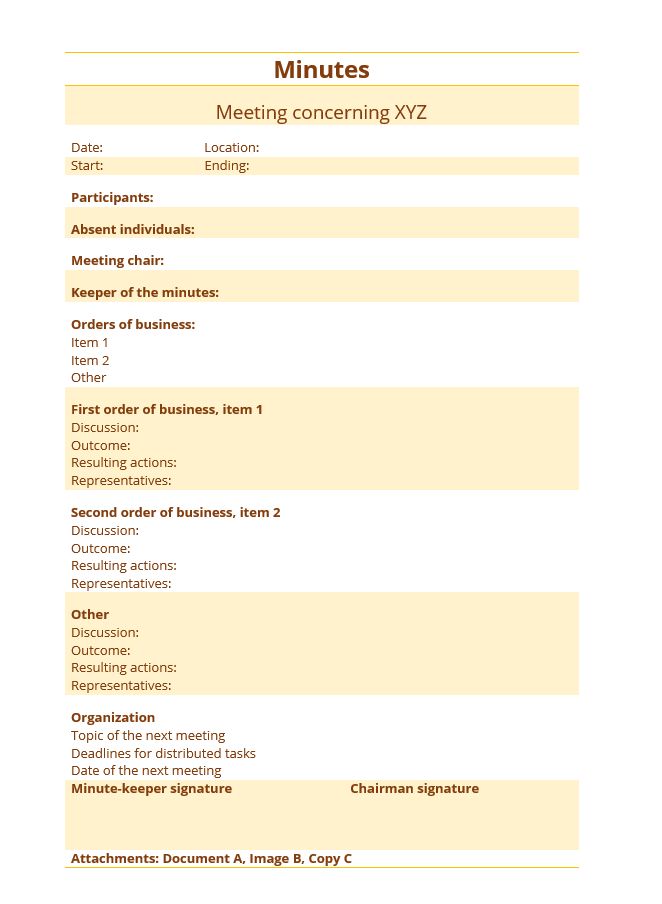
A clear structure increases readability. With uniform formatting of all recorded minutes, participants get used to the fixed structure and will be able to adapt quickly in the future. It can therefore be helpful if you create a template for minute takers. The following standard information belongs in every protocol:
The header: The header includes the place, date, and names of the participants. The meeting topic serves as a heading.
The main part: Here, you reproduce the discussed topics. In a result protocol, each thematic point is given its own paragraph. In this paragraph, you summarize arguments and debates on this topic. Means of visualization, on the other hand, belong in the appendix. You should also include counter-arguments to certain statements in the main part – especially if they raise questions that might be important for follow-up sessions.
The conclusion: At the end, you summarize the results and decisions of the meetings again. If tasks have been distributed, name the person in charge. Here, you also have room for an outlook for the next meeting. You indicate when the next meeting is scheduled. If appointments have been made, make a note of this. In the next session, these notes help document important progress. At the end of the meeting, the minutes usually include space for the recording clerk and meeting chairs’ signatures.
The Appendix: The appendix includes handouts of lectures, slides from presentations or documents with facts and figures on the subject, which clearly present information in the minutes.
If you are writing a transcript, you should also adhere to the stylistic conventions. Write objectively and concisely. Emotional evaluations or personal comments should not be included when taking the minutes. You should not write in the first-person perspective either. With quotations, on the other hand, you can emphasize significant arguments.
For resolutions and official motions you use direct speech, all other statements are written in indirect speech. Usually you take the minutes in the present tense, in some cases the past tense is allowed – but make sure you stay consistent whichever one you use! Avoid mental leaps and keep the minutes clear and understandable.
The key to a successful minutes record: the transcript
Apart from the memory protocol, no method can do without a detailed transcript. It is too easy to forget facts and circumstances. Speakers are understandably unhappy when they are assigned false statements or tasks. So don’t hesitate to ask questions during the session if something is unclear to you – while you might still be pondering over a matter you want to note down, the discussion continues on. Perhaps someone is talking in between while someone else is making an important argument. Or, you don’t know enough about a topic to be able to estimate whether you have correctly reproduced it in a shortened form. Before you write something down the wrong way, and have to correct it later, you’re better off doing it right the first time.
Also keep the following tips in mind if you’re wondering how to take the minutes effectively:
Be well prepared!
Are you minute taking a lecture? Speak to the person in advance, if possible. You may be able to use some of the materials provided (graphics, handouts) as preparation for your minutes. In addition, you can place them in the appendix at an early stage and do not have to ask for them afterwards. Clarify terms that are less familiar to you in advance. If it is a recurring event, take a look at the minutes of the previous session. This will remind you of the previous session and you will be prepared if you are going to follow up. Maybe you don’t know all the session participants? Research to quickly identify names and faces.
Keep a low profile!
There is no need to write a verbatim transcript for a business meeting. Concentrate on the most important topics and follow the discourse to the final decision. It helps if you keep the actual meeting topic in mind. If you want to include a longer conversation in your minutes, ask yourself: does this conversation really lead to a decision that is relevant for the meeting topic?
For example: You take the minutes during a meeting about the quarterly budget for acquiring exhibits in your local museum club. Two participants discuss whether to serve Black Forest Gateau or New York Cheesecake at the club’s next coffee morning. The answer is: both. However, it doesn’t matter for the quarterly budget, since the money comes from a different pot and the food has nothing to do with the exhibits. This means the subject doesn’t belong in the minutes.
Leave room!
It’s a simple trick, but it will save you a lot of work later on. When taking the minutes, leave space between each written line. Another option: at the end of complex topics, leave enough space for a further section. If the conversation turns back to a topic in between, just continue writing at this point. If you put your minutes together later, you can work through your topic complexities step by step and don’t have to structure the transcript thematically afterwards.
Shortcuts!
It doesn’t have to be professional shorthand. If you use abbreviations, simultaneous logging will be quicker for you. Develop or use a system that you can cope with on a permanent basis. Otherwise, you might forget later what the accumulation of letters is supposed to mean. Write the transcript using keywords if necessary.
Remain objective!
If argument and counter-argument alternate in a verbal exchange, as a group member you probably share some of the views of either person. Nevertheless, when recording the minutes, you must present both sides fairly. Even if you don’t like decisions, you have to be factual when writing minutes.
Get feedback!
If necessary, go through the notes again at the end of the sitting by reading them out. If a person then thinks that their speech hasn’t been presented accurately, they can object immediately. You can also fact-check for accuracy this way, all the while reminding all participants of the most important meeting points.
Start the final version in good time!
Begin the final version immediately, while the key aspects are still fresh in your mind. If you have questions, the participants will also remember them better and can answer your questions promptly.
The checklist for your records
So, you’ve recorded the minutes. But have you definitely thought of everything? Does the quality standard meet your usual requirements? Before you send the document to your colleagues on the mailing list, use our checklist to be sure.
Checklist for a successful minutes log:
- Does your selected minute-taking method follow the company’s style guide? Is it effective?
- If you use the result method, have you recorded all decisions, task allocations, and negotiation results in the minutes?
- When you write a progress report, does a red thread lead through the debate and does it show how the conversation develops?
- If you’re taking the minutes for a seminar, do you document the discussions and their resolutions? Are the results of the debate logical?
- Do the minutes contain all necessary framework information (participant with a correctly written name, date, session topic) and is it formally accurate?
- At first glance, does the document seem reader-friendly?
- At a second glance, are the sentences short and easy to read? Are the subject areas clearly defined?
- Are the contents of the minutes complete?
- Do you use the present tense throughout?
- Is your text free from judgmental statements and first person narration?
- Would you understand all the points if you hadn’t been present at the meeting?
- Have you clarified any ambiguities?
- When taking the minutes, did you sign or attach a digital signature to your minutes? For formal meetings, the minutes should be signed by the chairman, or ideally by all participants.
How to take minutes easily: a template
We’ve already discussed what you need to consider when it comes to the structure and content of a minutes record. Here is a sample that you can use when taking the minutes. The mixture of progress report and result method is particularly suitable for longer sessions. For short meetings, using the result method alone is often sufficient.
Summary: Recording the minutes provides more transparency
Minutes are used in many areas. If the parties involved, or even third parties, want to be able to reproduce certain decisions later, these written records help to understand the preceding decision-making process. If you want your employees to take the minutes in a meeting, you can convince them that minute-taking is useful by providing the reasons stated here. You can also use our tips and templates. This will result in less work, as well as informative, clearly structured minutes.
Click here for important legal disclaimers.
Reviewers

Anne-Laure Wolber
Anne-Laure has been part of the IONOS Digital Guide since its inception in 2016. As an expert in the startup category, she focuses primarily on the strategic integration of SEO, GEO, and conversion rate optimization. Over the years, she has also gained extensive experience in related performance disciplines such as lead generation and native advertising. As a polyglot, she leverages her multilingual background to develop content strategies with precision and impact for international audiences.

Christian Heldmaier
Christian Heldmaier is an experienced online marketing and SEO specialist from Karlsruhe. He has been working as an SEO Manager at IONOS since July 2020.