

Crowdfunding

Crowdfunding enables projects to be fulfilled without having to attract well-known investors. Instead, a large number of interested parties and fans finance the project directly e.g. through donations and loans. Crowdfunding is a relatively young concept that began in 2008 when Indiegogo was founded, then Kickstarter.com the year after. Since then, many well-known projects have been realized with the help of crowdfunding, including cryptocurrencies, music albums, software projects, video games, and innovative items for everyday use.
Crowdfunding refers to donation-based project financing where mainly private individuals support a project by choosing the amount they want to donate themselves. In most cases, a financing target is set and the donor is rewarded according to the amount of the donation made. The transparency of the project is essential for crowdfunding.
What is crowdfunding and how does it work?
Crowdfunding focuses on attractive and effective marketing to appeal to private investors. Because this form of financing is based on trust, the promise to potential donors mustn’t be too unrealistic, but at the same time it has to be inviting so that donors are prepared to invest in a project that has not yet been implemented. Therefore, transparency is crucial when it comes to crowdfunding. By keeping your donors up to date with the latest developments in your project, you strengthen the relationship and trust of your donor base on the one hand, and gain new donors on the other hand. In addition, other people will see that you are actually doing a promising job and will be more willing to donate.
Crowdfunding often has a snowball effect – the most successful projects can end up going viral on social networks. Sometimes this even results in so much hype that the goal is quickly reached and even surpassed. This isn’t always going to be the case, however. Nevertheless, crowdfunding projects often attract an astonishing number of voluntary donors. Most platforms show the amount of money that’s already been collected. By defining a financial goal, the donor base can always track the success of the crowdfunding campaign. So-called milestones can also be defined: the more money that’s collected, the more promises can be made about the end product. These milestones are often placed above the financing target so that the project reaches a larger scope than originally planned.
In addition, as the project leader you can reward your donors according to how high their donation is. It’s not unusual to make certain promises to more generous donors e.g. a free copy of your product when it’s finished, a premium version, a mention in the “credits,” special merchandise, admission to a special “VIP club,” and much more. Donors often receive a certain thank you for their donation before the project gets fully underway.
Crowdfunding models and examples
The four main crowdfunding models differ according to what the donors receive in return for their donations. The type of cash flow also plays a role. There are still no clearly defined terms for the names of the models, because these types of crowdfunding have emerged in a practical way in recent years. The boundaries between the models are often blurred: in the course of a campaign, pure donation crowdfunding can sometimes merge into the classic, reward-based model.
Crowdfunding/reward-based crowdfunding
Classic crowdfunding collects donations and, in return, promises an end product. Giving small rewards to donors has also become the norm in crowdfunding, which is why the term “reward-based crowdfunding” is often used. These rewards can be non-material rewards (being credited, beta access, priority on pre-orders, etc.) or material rewards (merchandise, prototypes, etc.). Donors are often rewarded according to the amount they donate.
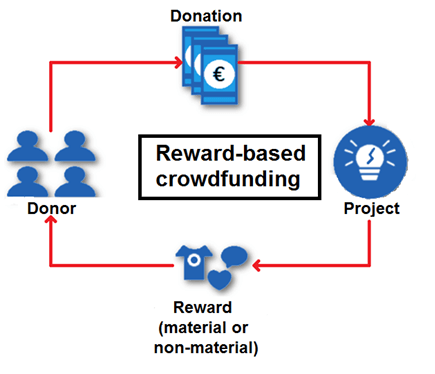
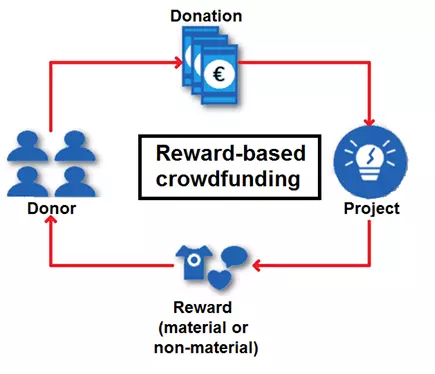
Example: A small development team is working on a concept for a new, innovative video game. Because the team can’t find any suitable business partners or investors, it has decided to try its luck with crowdfunding. By promising to have the game finished within the year, the developers ask for support in the region of $50,000. All donors will be thanked with a mention in the credits at the end of the game. If a donor gives more than $50, they get a t-shirt, and if they give more than $100, they are promised access to the game’s beta test phase. To lure particularly generous investors, the developers promise to feature the donor as one of the figures in the game if over $500 is pledged.
Crowdinvesting/equity-based crowdfunding
Crowdinvesting is also often referred to as “equity-based crowdfunding.” With this method, investors receive a share in the subsequent profit. This form of crowdfunding is mainly found in the start-up scene. The commercial success potential of the presented idea is decisive for successful crowdinvesting. If the potential is high enough, crowdinvesting can improve not only the financial basis of the project, but also its commercial reach. The viral nature of crowdfunding also increases the level of awareness of your own brand, so that new markets can develop.
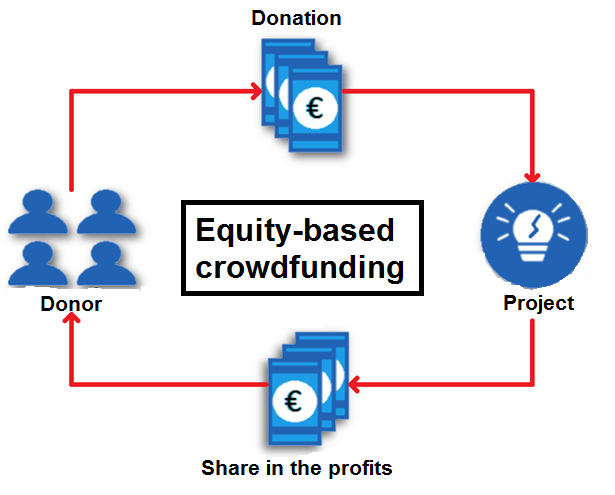
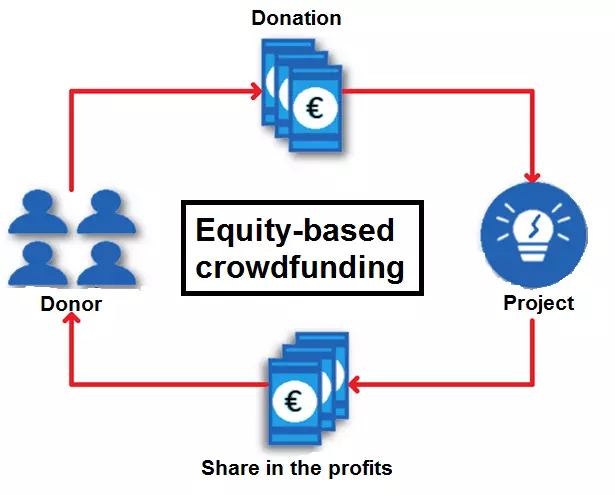
Example: A young startup company sells an environmentally-friendly soft drink locally, which is particularly popular among young customers. The company wants to expand across the US and commercialize the beverage. For this reason, it launches a crowdfunding campaign and promises investors a share of the subsequent profit, depending on the investment made. From a certain amount onwards, the investor is also promised a monthly beverage subscription.
Donation-based crowdfunding
This model is actually the simplest of them all: donations are simply collected without promising the donors any rewards. In the past, this concept was simply referred to as a “fundraiser” or “charity collection,” but in the course of digitalization, many of these campaigns are being considered as crowdfunding. This type of fundraising can simply be organized via an online platform.
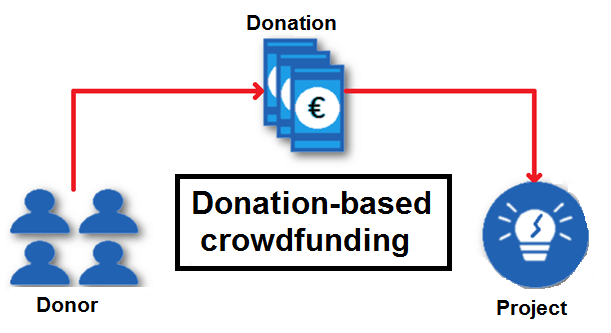
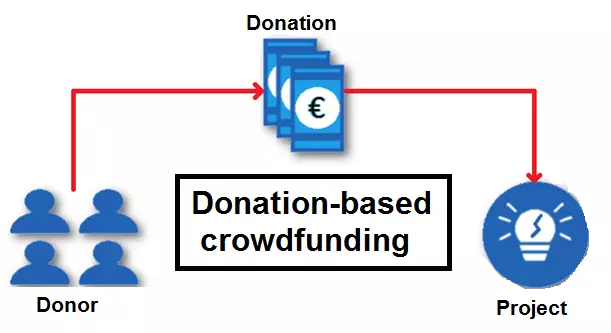
Example: The local community really wants a new soccer field, but the city refuses to finance the project. A small team of parents uses a crowdfunding website to collect donations from local residents. They also share their donation page on many social networks. Because the site is open to the public and donations can be accepted throughout the US, the team gets a surprise! A well-known soccer player becomes aware of the campaign and makes a considerable donation.
Crowdlending
Also known as peer-to-peer lending and lending-based crowdfunding, in principle, this type of crowdfunding works through many small loans. A certain interest rate is agreed upon with investors: compliance is usually negotiated by a reputable institution. In contrast to crowdinvesting, crowdlending involves repaying the money that has been loaned, including the interest, back to the “donor” after the project has successfully launched. Because crowdfunding doesn’t run through a bank, the company can book and tax the money collected in this way as equity. This, in turn, can be helpful in meeting certain conditions for bank loans.
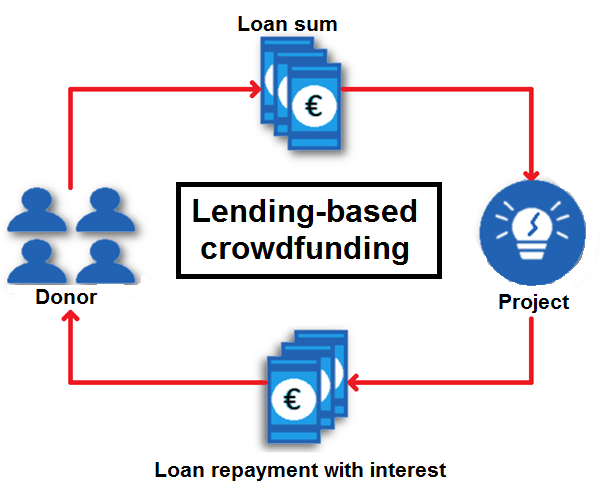
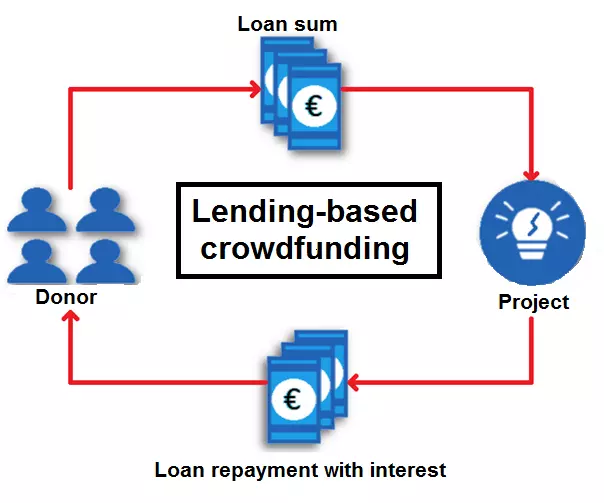
Example: A startup company wants to invest in a new project, but lacks the funds to do so. The bank won’t provide a loan, since there’s a required equity quote of at least 30%. The startup starts a crowdfunding campaign and promises investors that they will repay the loan amount at an interest rate of 5% after two years at the latest. Within a few months, the necessary capital will be reached, so the bank can now also get on board. Work on the project can begin.
Factors of a successful crowdfunding campaign
Impressive projects have already been implemented thanks to crowdfunding, but on the other hand, there have also been numerous disappointments, some of which have caused a lot of damage. Crowdfunding is not a miracle cure for project financing and requires a lot of work and also ingenuity on the project developers’ side. Successful crowdfunding is based on many factors interacting. You should:
- Stay realistic. Both the project planning and the financing target must be realistically defined – and these depend on many factors. You should not ask for more money than is needed in your industry and make sure the amount is suited to the size of your project. Comprehensive finance planning is indispensable to set the most realistic goal possible. Only when you know what the project will cost you, will you be able to give your donors a credible funding target. The project description itself shouldn’t be too excessive: if you promise too much, you won’t be taken seriously. Crowdfunding donors have become more skeptical in recent years due to being left disappointed in the past. So make sure the skeptics have nothing to doubt.
- Stay transparent. It’s important to keep communicating with your donor base to maintain confidence in your project. Ideally, regular updates are used to signal that things are actually happening. This also increases the probability of your project attracting more attention and also more donors. Finally, it motivates the donor base if they see that the donations have made a difference. Donors who have already been won over are more likely to provide further support. Maintaining communication between you (or your team) and donors and actively contributing will help in achieving the funding goal for your project.
- Appear competent, but remain approachable. The content you share should be as professional as possible. Videos and images shouldn’t look amateurish and texts should be free of typos. At the same time, however, it’s important to stay approachable for your donor base. This also depends on the target group: for example, you can be more relaxed about a video game project than a software project that is mainly aimed at companies. The right balance is crucial here in order to have a sympathetic effect on donors. Many of the unwritten rules of online marketing also apply to crowdfunding.
- Keep your promises. If you reward donors for pledging certain amounts, you should stick to your promise. This strengthens your relationship and increases the chance of them wanting to advertise your project. Ideally, you should define rewards and promises that you can deliver or implement as quickly as possible. A popular reward for donors is merchandise such as t-shirts and caps, as these are produced relatively quickly. Including a project logo means that articles can be used for effective advertising. Be sure to keep your promises regarding updates on your project. For example, if you are announcing a weekly blog post about the status of your project, you should deliver this on time. It doesn’t do any harm to show some progress with tweets and Instagram posts in between.
Advantages and disadvantages of crowdfunding
| Advantages | Disadvantages |
|---|---|
| ✓ A lot of freedom in project planning without undesired compromises. | ✗ Constant pressure to perform can lead to frustration or failure if you don’t meet the requirements you’ve imposed on yourself. Counter-hype endangers the project. |
| ✓ Project undergoes market testing: if the idea is bad or presented badly, it won’t be financed. Feedback is also collected at the same time. | ✗ Disclosing the project plan and showing progress promotes plagiarism and idea theft from competitors. |
| ✓ Building a crowd or community around the project: possibility of generating hype and causing viral spread in social networks. | ✗ Great competitive pressure: crowdfunding platforms today are very overcrowded with many absurd projects; your project must immediately be able to set itself apart from the rest of the projects and stand out from the competition. |
| ✓ Direct donation financing is usually more cost-effective than intermediary financing (e.g. bank loans). | ✗ The crowd has all the characteristics of an online community, including the toxic ones: you have to be able to deal with trolls, unjustified and excessive criticism as well as personal attacks. |
| ✓ Constant communication with the crowd, as well as feedback, can be motivating and guarantees the constant flow of fresh ideas. | ✗ Crowd management can sometimes be time-consuming and can distract from the project’s progress. |
| ✓ The success of the end product can be estimated better by analyzing the crowd. | |
| ✓ The need for competent project planning and constant updates leads to efficient and concentrated work on the project. |
You can get crowdfunding campaigns started on many different platforms. In our digital guide, we introduce you to the most popular crowdfunding websites.
Examples of successful crowdfunding campaigns
Blockchain/cryptocurrency technologies: Filecoin, Tezos, EOS
Among the most successful crowdfunding campaigns are numerous blockchain/crypto projects. Filecoin from Protocol Labs is an application for decentralized data storage and enables a digital payment process based on blockchain technology. With approximately 257 million US dollars, Filecoin is the most financially-successful crowdfunding project to date. This is followed by the Tezos (232 million) and EOS (185 million) projects, which are also related to blockchain.
However, the term “crowdfunding“ is disputed in many of these campaigns. They are within the speculative bubble of the cryptocurrencies, meaning that contributors usually receive “only” a certain amount of the respective cryptocurrency as equivalent. Instead of developing a certain self-interest and enthusiasm for a project, donors usually speculate on the success of these campaigns, which is fed by the general hype surrounding cryptocurrencies. This is why crowdfunding campaigns regarding blockchain and cryptocurrency are more like stock market speculation. The fact is: the crowdinvesting model seems to be the ideal breeding ground for cryptocurrencies.
Video games: Star Citizen and Undertale
Crowdfunding has a considerable influence on the video game industry and has already helped many independent developers realize their projects. The mega video game project Star Citizen ranks fourth behind the three blockchain projects mentioned above. To date, the game has collected around 180 million US dollars, clearly setting itself apart from the competition. Star Citizen is a kind of space sandbox game that promises players unlimited freedom and combines several popular video game genres. The crowdfunding campaign for Kickstarter was extremely successful and helped the project generate hype online.
However, the project generated the most revenue by selling individual content for the upcoming game. Depending on the amount transferred, donors can “pre-order” spaceships, objects, and properties in the game. The crazy amounts helped Star Citizen to gain even more fame when people realized some four- and five-figure donations had been made. These donors hoped to enjoy certain advantages when the game was released. This also resulted in a corresponding media response. This means that a lot of pressure is put on the project to deliver the promised quality and scope. Donors have to be patient: targeted release dates and milestones may need to be postponed several times by the developers.
In contrast to Star Citizen, minimalism is key for the cult role-playing game Undertale by Toby Fox. The Kickstarter campaign was initially small with a financing target of 10,000 US dollars. However, the developer managed to make more than $50,000. The end product ended up exceeding all expectations and became a cult hit and one of the most successful indie video games of all time. It won numerous awards including “Game of the Year” from The Jimquisition and Zero Punctuation, and the SXSW Gaming Awards named it the “Most Fulfilling Crowdfunded Game.”
Undertale, whose retro aesthetics are reminiscent of games from the 1990s, was Toby Fox’s personal project for the most part. The game is rather unconventional when it comes to its story, humor, and gameplay. It achieved impressive sales figures and was later ported to PlayStation 4, PlayStation Vita, and Nintendo Switch. An inspiring success story, which was made possible by a relatively small crowdfunding campaign that allegedly made Toby Fox a millionaire.
Food: Flow Hive
The Flow Hive is an innovative beehive that allows beekeepers to automatically extract honey without disturbing the bee colony. This makes the classic honey extractor superfluous. The project raised approximately 13 million US dollars and by March 2018 around 50,000 Flow Hives had already been delivered. Flow Hive is the most successful project financed by the Indiegogo platform. In addition, Flow Hive has been further developed after receiving some criticism, so now a second version is available. The successful project generated a lot of attention on social networks and in the media, and many people started to take up beekeeping as a hobby.
Software: FirstBlood
FirstBlood gives gamers from all over the world the chance to compete against each other on a decentralized platform. FirstBlood aims to revolutionize the young and still largely inefficient field of eSports. Innovative is the own reward system, which works similarly to a cryptocurrency via blockchain technology. In addition, members can use this currency to invest in the game, players, and teams, and take on certain roles in the community e.g. as a “jury member” and “witness,” which is then rewarded with virtual money. The idea was born: within just a few minutes, around 5 million US dollars were collected, with cryptocurrency being provided in return, depending on the amount donated. In addition, investors received a 70% discount on the currency within the first hour of the campaign.
Examples of unsuccessful or controversial crowdfunding campaigns
Crowdfunding has become very popular over the years, the abundance of available platforms alone speaks for itself. However, in addition to the innovative and interesting projects, there are also numerous nonsense and controversial campaigns, some of which have been mocked by the online community.
A more harmless example can be found with project manager Zack Danger Brown, who only asked for 10 dollars to make his first potato salad. The 55,000 dollars he collected probably helped make his potato salad dreams come true. It should also be said that Brown actually donated most of the money to an aid organization.
Rapper B.o.B., a self-confessed flat earther, left a lot of people scratching their heads. On his GoFundMe page, he wanted to collect 200,000 then later 1 million US dollars to send a satellite into space. His plan was to photograph the “edge of the world” and prove that the Earth is, in fact, flat. Until now, B.o.B. has only been able to collect 7,000 US dollars, but he has caused a media frenzy. In any case, the question is whether these types of crowdfunding projects are actually just clever PR campaigns in disguise.
Crowdfunding platforms are full of questionable campaigns that often make you wonder if they are serious. Some want money for their wedding or honeymoon, others for a tattoo…etc. Many use the platform for political reasons, which are sometimes even racist. The websites aren’t protected from trolls who just use them to let off steam. While many projects remain unnoticed and unfinanced, many ludicrous and downright ridiculous campaigns do attract social media attention. This is another reason why the crowdfunding concept is repeatedly exposed to criticism, as many come there to ridicule the campaigns on there. Funny crowdfunding campaigns are now considered an integral part of meme culture.
Vehicle industry: Elio Motors
Elio Motors’ concept of an environmentally-friendly and economical car with three wheels was well received by investors. About 6,000 individual donors supported the project by pledging around 100 million US dollars, which far exceeded their own goals. The crowdfunding campaign was very successful – but the result is yet to come. Elio Motors originally wanted to launch the first version of its innovative vehicle as early as 2012, but to this day still hasn’t managed to do so. According to the latest data, production is scheduled to start in 2019. Either way, the delivery promise has not been kept so far and investors must continue to be patient. Nevertheless, thanks to the effective campaign, huge sums of money have already flowed in. It is unclear where this money has gone: by the end of 2016, Elio Motors’ debts allegedly amounted to over 100 million US dollars.
Video games: Mighty No. 9
The video game Mighty No. 9 from Comcept, which was financed by Kickstarter, promised to be similar to the popular “Mega Man” classics and won people over due to nostalgia. The campaign, which features renowned developers, generated almost 4 million US dollars, which made supporters and fans of the project optimistic. However, the release of the game had to be postponed several times until it finally came onto the market for several platforms in 2017. The game was slammed by fans and critics, since the quality was quite average and didn’t live up to expectations. To the annoyance of investors, the rewards (mainly digital) were poorly managed: some bonus codes were faulty and incorrect rewards were sent out. Some donors, who had pre-ordered, never even received the finished product.
Mighty No. 9 has certainly made people vary of crowdfunding for video games, since the initial euphoria might not necessarily lead to success in the end. In general, this project shows how hype and counter-hype work in crowdfunding, and how a community (that is formed around a project) can react with so much disappointment when promises aren’t fulfilled.
Reviewer

Anne-Laure Wolber
Anne-Laure has been part of the IONOS Digital Guide since its inception in 2016. As an expert in the startup category, she focuses primarily on the strategic integration of SEO, GEO, and conversion rate optimization. Over the years, she has also gained extensive experience in related performance disciplines such as lead generation and native advertising. As a polyglot, she leverages her multilingual background to develop content strategies with precision and impact for international audiences.