What is a DApp (Decentralized Application)?

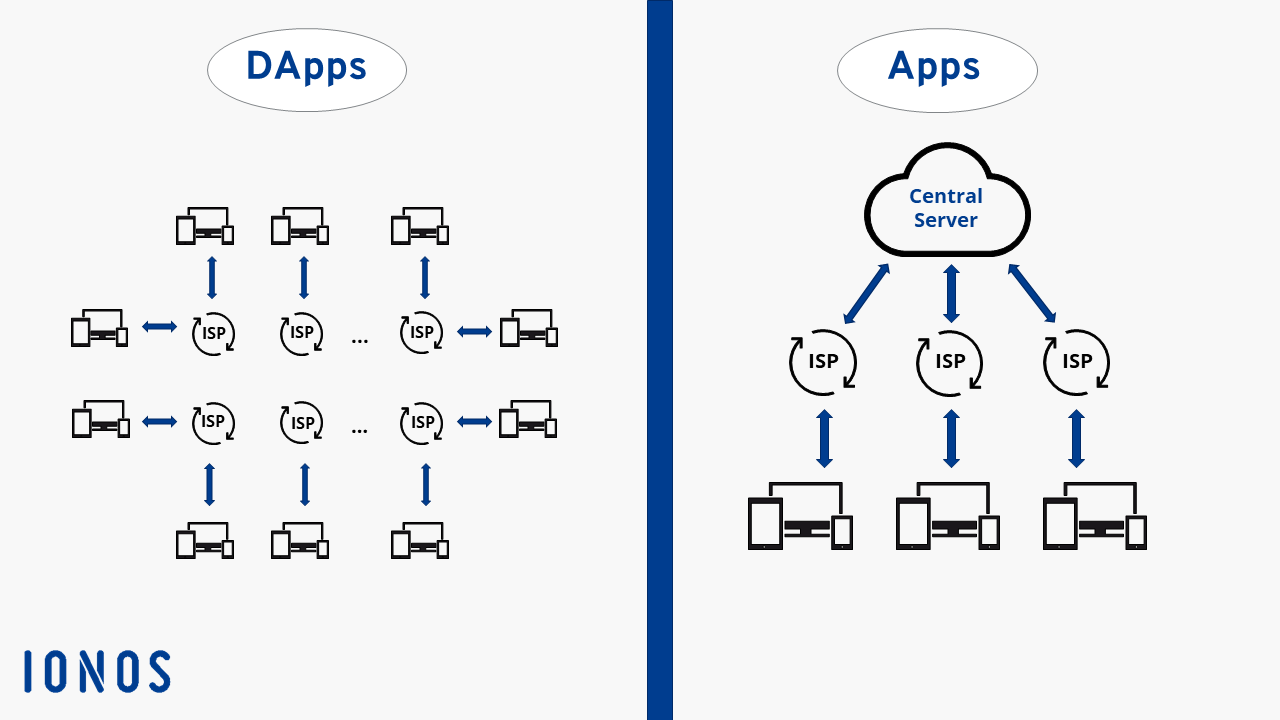
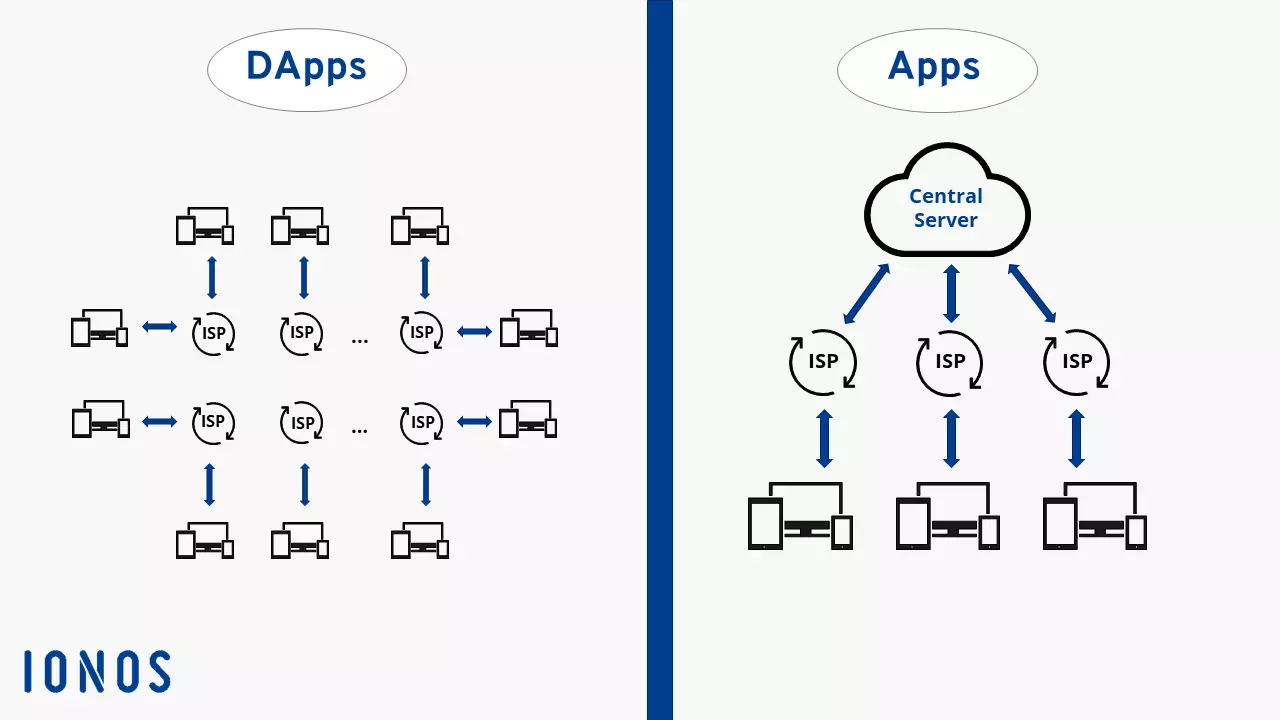
A DApp is a decentralized, open-source application that operates on a blockchain and uses cryptographic tokens for transactions. Unlike proprietary apps that are owned by a company and managed by central servers, DApps use a fail-safe peer-to-peer network. They’re also expected to play a central role in the development of a blockchain-based, decentralized Web3 Internet.
A closer look at DApps
The term DApp stands for “decentralized application”. DApps are autonomous applications that don’t depend on company servers but instead use a decentralized peer-to-peer network. The storage of data, communications, and transactions is based on a blockchain. In addition, DApps use transparent, open-source code that can usually be viewed by users and be used free of charge.
What makes DApps special?
To be considered a decentralized application, DApps must meet the following conditions:
- Uses open-source code
- Based on a blockchain
- Uses cryptographically encrypted tokens
- Enables the generation of tokens
Let’s take a closer look at the four key characteristics of decentralized apps:
Open-source code
DApps are based on the open-source principle. The software uses an open-source code formulated in a specific programming language that is visible to third parties, freely usable, and modifiable. Changes to the open-source code of a DApp is not dependent on companies or administrators.
A counterexample are idiosyncratic changes to the layout and functionality of Instagram, which regularly lead to user protests. DApps are based on a more democratic principle and adapt to community-suggested changes, market developments, and a consensus among developers.
With the success of cryptocurrencies, it became apparent that many decentralized apps didn’t rely on open-source code but instead on proprietary code. In 2019, only 15 percent of available DApps proved to be open source, while a quarter of all DApps used proprietary source code.
Blockchain
The storage of source code, transaction data, and logs in decentralized apps are based on a blockchain. Blockchains use decentralized peer-to-peer computer networks distributed around the world. In contrast to centrally managed apps like WhatsApp or Telegram, there’s a lower risk of hacks and outages since user data isn’t stored on dedicated corporate servers.
DApps offer higher security because attacking a blockchain network means targeting its individual computers to break the cryptographic encryption. This is almost impossible with a DApp, because computers are networked together.
Cryptographic tokens
Cryptographic tokens are linked to the decentralized, encrypted blockchain. Tokens are digital, encrypted copies of data that are stored in the blockchain. Among others, tokens can be cryptocurrencies like Bitcoin in the Bitcoin blockchain. These can be used to instigate trades or generate and verify new tokens through mining.
Generated or exchanged tokens are stored with transaction data as a digital copy or forgery-proof transaction certificate in the blockchain. On the one hand, this prevents fraud and hacks. On the other, it makes administration unnecessary. Verification takes place in a decentralized peer-to-peer network of miners and not via a central, hierarchical administrator.
Token generation
To use a DApp and exchange, buy, or sell tokens, DApps must generate cryptographic tokens. In the Bitcoin or Ethereum blockchain, a proof-of-work algorithm is used for this. Bitcoin, for example, uses an SHA-256 algorithm. The combination of an algorithm, cryptomining, and hashing, i.e., the generation and verification of tokens by solving a hash function, DApps fulfill the token generation criterion.
What differentiates DApps from other apps?
These are the main differences between DApps and centralized apps:
- Unlike apps, DApps aren’t managed as proprietary software by a central entity such as a company or system administrators.
- The source code of DApps is usually open source, publicly visible, free to use, and modifiable.
- System and user data isn’t stored, shared, processed, and edited in company-owned servers, but in decentralized, globally distributed peer-to-peer networks.
- The basis of DApps is a decentralized backend, managed by users in a blockchain network.
- Communication in DApps doesn’t happen via the provider’s servers, but via a globally distributed, decentralized network of devices and servers.
- Transactions are encrypted in a blockchain and verified and documented using smart contracts.
Smart contracts and DApps
Smart contracts are another important part of DApps in the backend code of the blockchain. This refers to code that functions like a contract and enables verified, official token transactions between DApp users. Once users meet the terms of the smart contract, the program code for a transaction is executed and stored in the blockchain. Since smart contracts can’t be changed or manipulated, they enable transparent, tamper-proof transactions.
A smart contract’s terms and conditions state what fees blockchain miners receive for executing and verifying transactions. Smart contracts are often written in the object-oriented programming language Solidity. Although multiple smart contracts can be used for DApps, more than 75% of current DApps use only one smart contract at a time (as of September 2022).
What are the pros and cons of DApps?
| Pros | Cons |
|---|---|
| ✓ Operate independently of companies or corporate servers via a distributed, decentralized blockchain network | ✗ Performance and scalability of a DApp depends on the performance, scalability, and hash power of the blockchain |
| ✓ Are fail-safe, tamper-proof, transparent, and hard to hack | ✗ Large companies like Meta or Microsoft offer better performance and usability with proprietary apps |
| ✓ Are protected against government interference, censorship, and manipulation | ✗ Only work online through a decentralized, peer-to-peer approach and need a connection to the blockchain |
| ✓ Enable users to develop and influence backend development | |
| ✓ Financial transactions via DApps don’t require intermediaries like banks or other financial institutions | |
| ✓ More anonymity and data protection, as user data isn’t shared with commercial companies with non-transparent data processing | |
| ✓ Wide range of applications and active further development by users |
What are DApps application areas?
DApps are an important part of Web3. Web3 is a new generation of Internet that is building a future based on blockchains and decentralized networks. And they already play an important role in transactions within decentralized networks. The development and application of DApps is boosted by users’ self-programming with blockchain and programming skills.
Possible areas of application include, among others:
- Finance: DApps promote decentralized financial transactions and trading that doesn’t require financial institutions as intermediaries. Instead, monetary protocols for transactions are used. Possible applications include loans, bonds, investments, barter transactions, and auctions.
- Gaming and NFTs: Various gaming DApps enable trades and “games” with an NFT. You can use these to earn money with NFTs by creating, collecting, trading or betting with them.
- Browser: DApp browsers connect to decentralized apps, let you browse DApps over blockchain networks, and provide an integrated wallet for crypto payments.
- Social networks: Decentralized social networks like Leeroy are an alternative to centralized social media companies like Meta or Twitter, which have questionable privacy credentials.
DApps in practice
Well-known DApps with large communities include:
- Rarible: Rarible is a decentralized application that acts as an NFT marketplace. NFTs can be created, sold, and purchased. Other ways to earn money include art trading and trading collectibles.
- TraceDonate: This DApp service uses crypto wallets to donate to charities.
- Minds: The social media DApp Minds uses open-source code and reliable user data encryption.
- 1inch: A stock exchange DApp that can be used to split stock exchange transactions and trade on multiple DEXs at optimal conditions.
- Ipse: A decentralized search engine based on the Interplanetary File System and the EOS blockchain. Thanks to asymmetric encryption, Ipse promises more anonymity and data protection.
- Pancakeswap: One of the largest decentralized exchanges for cryptocurrencies that can be used as a DApp. It serves as an intermediary platform for the exchange of BEP-20 tokens.
Reviewer

Christian Heldmaier
Christian Heldmaier is an experienced online marketing and SEO specialist from Karlsruhe. He has been working as an SEO Manager at IONOS since July 2020.