

Continuous Integration vs. Continuous Delivery vs. Continuous Deployment

Software development processes are expensive. When the finished code cannot be smoothly integrated into the existing software it can mean that development costs skyrocket. The modern approaches of continuous integration, delivery, and deployment provide a solution. These rely on validating the code multiple times as it is being developed. Working in several smaller development phases also allows prototypes of the desired product to be delivered to the customer. This allows the customer to adjust its requirements throughout the development and see if the software is developing as desired.
- Great premium TLDs at affordable prices
- Simple registration & transfer
Agile Development
Modern software development models all began with the concept of agile software development. This is an approach that is intended not only to accelerate software development, but also to make it more transparent. The goal of the agile approach is to develop software that the customer really needs. Prototypes provided during each phase of development allow the customer to check whether the software actually does what it is supposed to do and whether it is compatible with existing software. Customer requirements that only arise during the development process can also be taken into account with agile methods.
A classic development process in the field of software consists of four phases: specification, development, validation, and evolution. First, the customer specifies their requirements. Next comes the actual development phase, in which the code is written and the project is completed. Afterwards, the developers check with the customer whether the software works correctly. In the evolution phase, the software is adapted to changing requirements and environmental conditions. Agile development methods, however, rely on a much more small-step approach and repeat the individual phases incrementally. This allows a much more flexible response to changes.
DevOps
The trend towards agile development is also picking up momentum in corporate cultures. There are several approaches that are intended to accelerate development processes within the company. One of them is DevOps, made up of the words “development” and “operations”. The goal of this corporate culture is for the actual development teams to work together with an operation’s organizational team throughout the software development phase and beyond. This way any software integration problems can be avoided from the outset. It also makes it easier to maintain and deploy the finished programs. In addition to continuous development, representatives of DevOps rely on continuous integration and continuous deployment.
Software development models in comparison
Continuous Integration
The concept of continuous integration aims to incorporate changes to a software project into the entire software as quickly as possible. The code is therefore updated daily by the developers. For this purpose, in addition to various continuous integration tools, version control systems such as GitHub are primarily used. These allow local copies of the entire project to be stored on one’s own computer. Programmers can make changes to the code and upload them to the version control system. Afterwards, the entire program can be subjected to various tests. This means that any integration problems can be avoided in advance.
Continuous Delivery
The continuous delivery concept goes one step further than the continuous integration approach. Not only is the code updated daily and every change integrated as quickly as possible, but the customer is also provided with a prototype as soon as possible. The continuous integration vs. continuous delivery comparison shows that the focus of continuous delivery is primarily on customer feedback. By being able to deliver the finished partial code early, it makes it possible to test the system software in its real environment. Anything that the customer does not like can be adjusted during further development. If the customer likes the partial code, it is subsequently handed over manually.
Continuous Deployment
Continuous deployment follows a similar, but even more extended approach. This method uses automated tests that are integrated directly into the development process. The comparison of continuous delivery vs. continuous deployment makes it clear that with continuous deployment there is no time delay between the time of testing and the time the code is released. Due to the detailed test frameworks, developers do not even have to wait for feedback from the customer - they can deploy their partial code directly after it has been developed in an automated manner.
Continuous Integrations vs. Continuous Delivery vs. Continuous Deployment
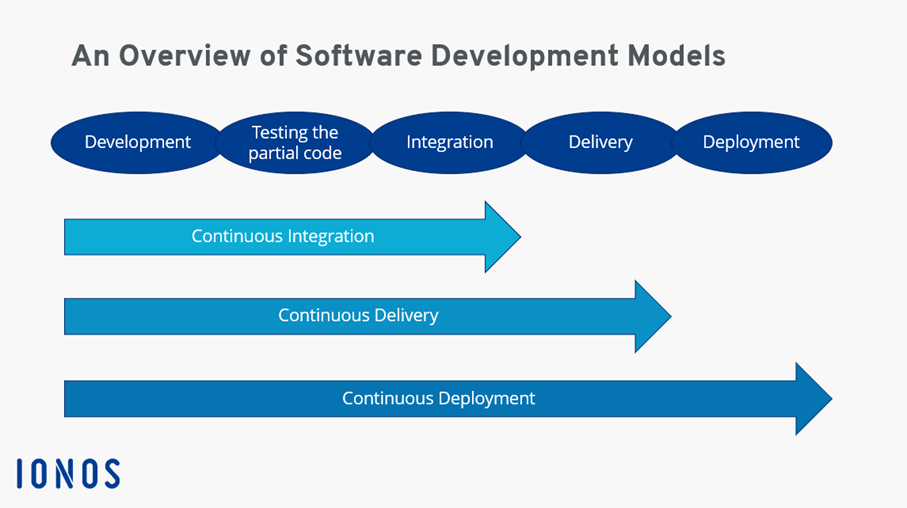
Which development model is best depends entirely on the project’s specific requirements. Overall, however, all three models offer the most advantages if the customer and developers can work closely together.
Continuous deployment is expensive due to the elaborate testing procedures, but it means that the customer is able to see daily improvements to the software. In addition, the development process is accelerated because it is not interrupted at any point. This means that it is often possible to recoup the additional costs for the test frameworks in the end. With continuous delivery, the customer still has a great deal of room for maneuver - requirements can also be specified retrospectively without causing any problems. Small changes to the code are also easy to make.
A comparison of continuous integration vs. continuous delivery shows that continuous delivery completely forgoes interim code release. This process is therefore particularly suitable for smaller projects where constant updating is not important or may even be a hindrance.
Want to automate the development process of your web project? With IONOS Deploy Now you can deploy your GitHub repositories directly to the IONOS infrastructure and live track changes to your website.
Reviewers

Julia Hertler
With over 18 years of experience in content marketing, Julia Hertler has deep expertise in digital communications. For the past 10 years, she has specialized in the areas of domains and hosting at the IONOS Digital Guide, making complex technical topics easy to understand.

Christian Heldmaier
Christian Heldmaier is an experienced online marketing and SEO specialist from Karlsruhe. He has been working as an SEO Manager at IONOS since July 2020.