Software-defined storage

Finding an appropriate storage model for a company, is often much more difficult than one thinks. Aspects such as acquisition costs, the security package on offer or the administrative effort associated with a dedicated solution play an important role in making a choice. As an alternative to a file server or popular solutions such as NAS (Network Attached Storage) or a storage-area network, the so-called software-defined storage (SDS) has come to the fore. What exactly this storage concept is, you’ll learn in the following article.
Cost-effective, scalable storage that integrates into your application scenarios. Protect your data with highly secure servers and individual access control.
What is software-defined storage?
Software-defined storage is a storage architecture for computer systems in which the storage management software is separated from the basic hardware. With a structure that’s based on the concept of virtualization, a SDS storage environment for this purpose relies on a universal interface for accessing storage resources, rendering specific software for the administration of individual storage devices unnecessary. In this way, the entire storage capacity of the different hardware components can be centrally bundled and scaled in any dimension, or disseminated to the accessing clients. This makes the entire storage architecture more flexible and cost-effective. With the help of software-defined storage, software can also define specific guidelines for managing the storage, as the following aspects show:
- Data deduplication: Identification and elimination of unnecessary data copying
- Replication: Multiple storage and synchronization of the same file
- Thin provisioning: “Lean” storage allocation, where only the storage that is actually needed is reserved
- Snapshots: Virtual data maps
- Backups: Solutions for data backup
In the meantime, SDS as a storage solution for SMB and enterprises is now offered by numerous providers, which is why the concrete implementation of the concept often looks very different. At the same time, many providers are happy to offer software-defined storage as subcomponents of software-defined data centers, in other words, virtualized data center resources.
With IONOS you’ll also find a software-defined data center that includes software-defined storage. With the Enterprise Cloud you’ll receive your own, private data center with resources you can conveniently scale and adjust to your needs using the exclusive Data Center Designer (DCD).
How does software-defined storage work?
The central point of software-defined storage is to generate a monolithic storage architecture. All of the storage that is available is thus condensed into a homogenous entity, which is why no limits are set with respect to the hardware being used. It doesn’t matter whether it’s a fiber channel or iSCSI storage networks, SAS or SSD storage devices, or flash memory. Specific hardware and storage/network concepts are, for this reason, not necessary. Instead, they are simply combined and connected to one another.
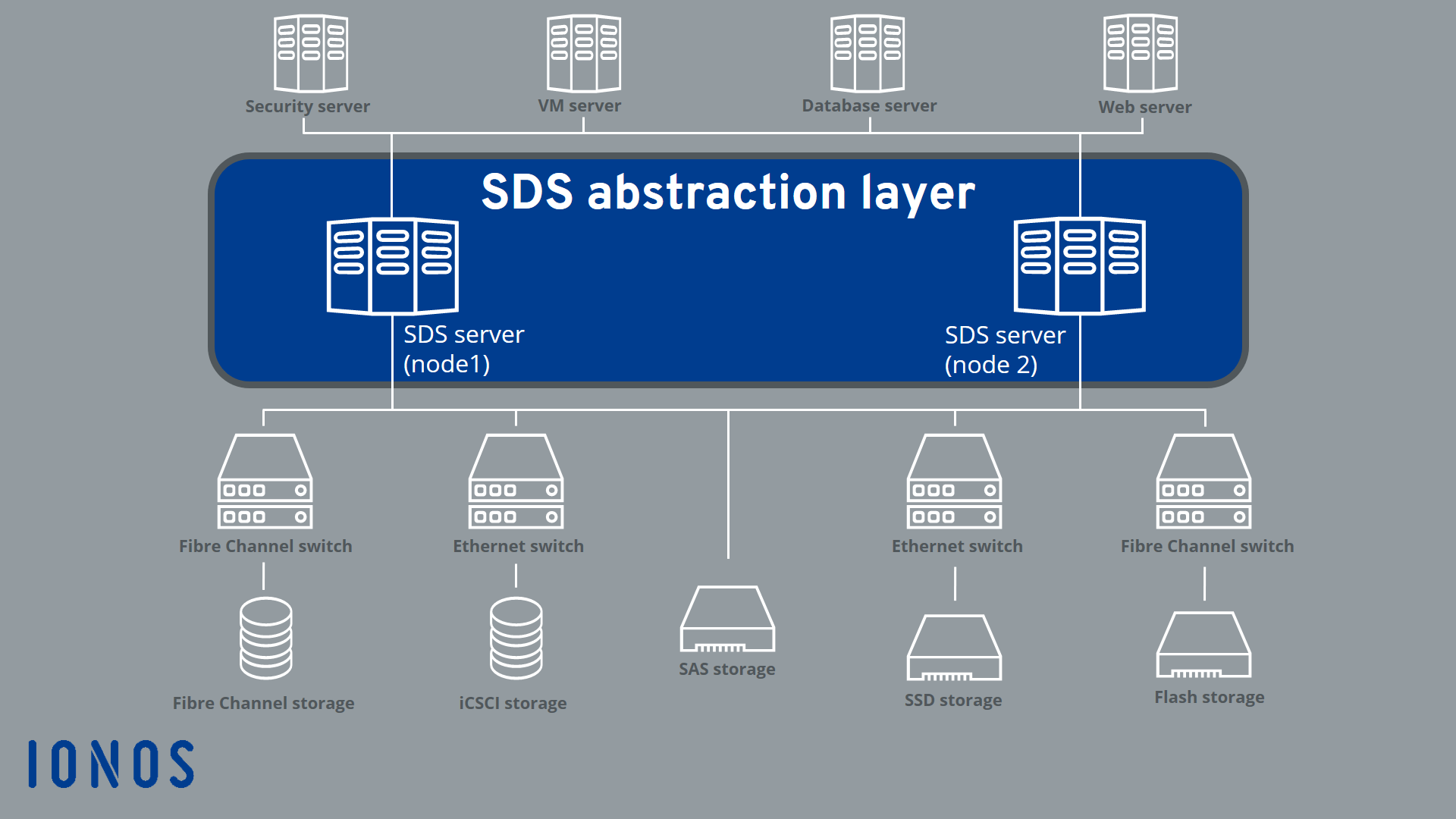
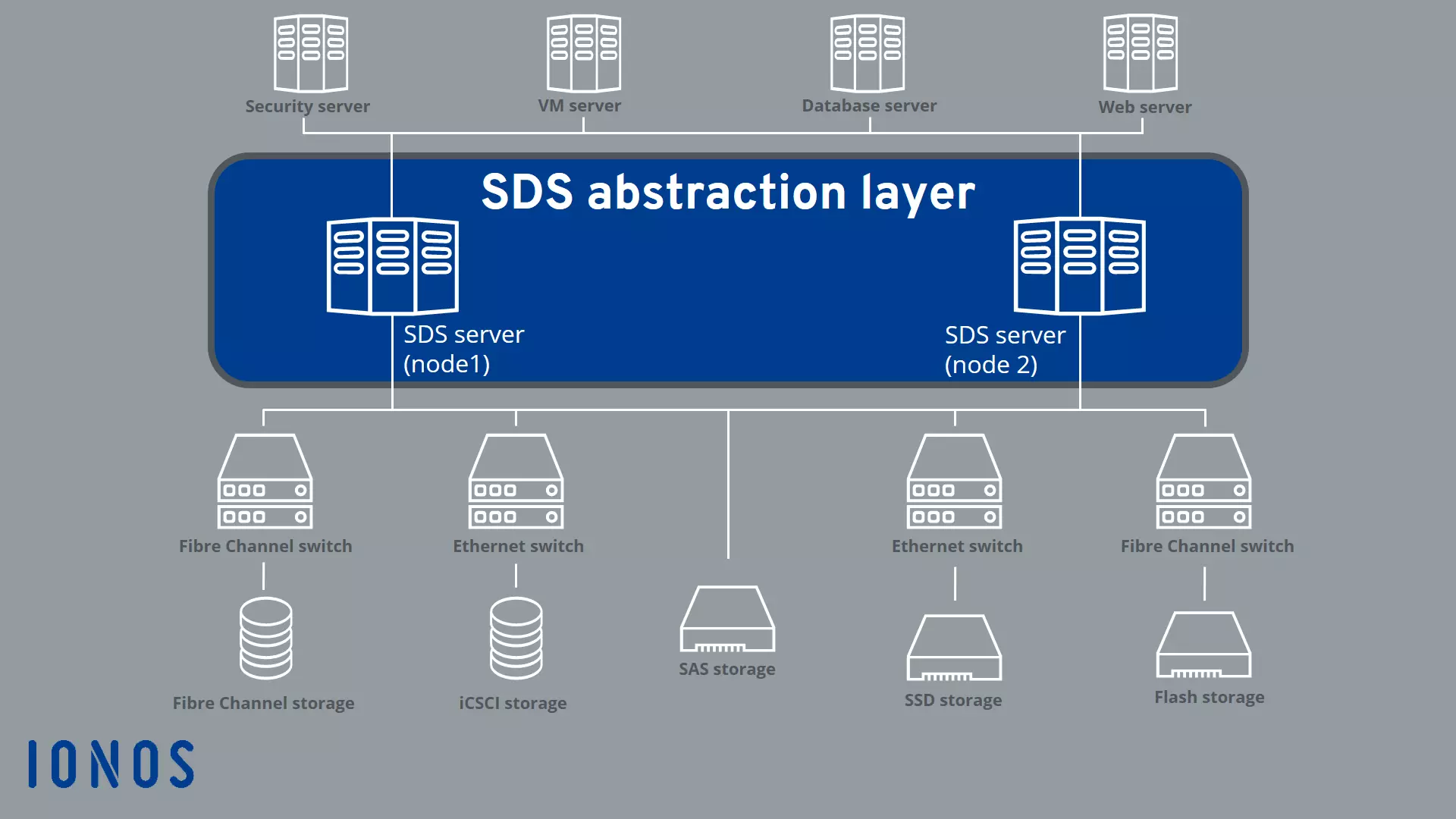
In order to achieve this independence from the device manufacturers and device types, SDS storage solutions rely on an abstraction layer between the physical storage and the data inquiry accessing it. Full control over this intermediate layer is subject to the respective provider, who can thus regulate how and where new data is stored. Users of a software-defined storage solution, in turn, receive a compatible SDS application from the respective provider, which can be used to regulate the separate memory requirements. If more space is required for the storage of data, for example, the capacities can be adjusted upward at any time – analogous to this, one can reduce the storage space that is available if the resources are no longer required.
The advantages of software-defined storage
Software-defined shortage offers numerous advantages when compared with traditional storage solutions such as the NAS (Network Attached Storage) or SAN (Storage Area Network) architectures mentioned above. First and foremost, is the great flexibility that accompanies the cutting-edge concept of virtualization. There is no dependence on the hardware and software of a specific manufacturer, nor is there a specification for the structure of the basic storage media. For this reason, the exchange of defective or outdated hardware is just as effortless as the acquisition of new equipment (x86-based storage is quite sufficient). Furthermore, the following benefits speak in favor of the use of software-defined storage:
- High efficiency: The hardware components in an SDS storage environment operate as a single individual, logical unit, and for this reason can be scaled horizontally (is also referred to as “scale out”). As a result, the storage resources can be distributed very efficiently to the separate applications. Furthermore, the capacity can be increased during operation.
- Easy connection to different data sources: Regardless of whether it’s complex storage area networks, external drives, HDD, SSD or flash memory media, virtual servers or cloud-based storage – with the software-based approach, the most diverse data sources can be merged into a uniform storage volume.
- Lower administrative effort: As a software-defined storage environment is set up, administrators benefit from the high degree of automation. For this reason, the administrative effort is limited.
- Increased security and availability: The independence from dedicated hardware gives software-defined storage excellent protection from data loss due to defects in one or several storage components. For example, in case of a breakdown, another component can take the place of the storage network. This also includes optional security features such as data replication.
- Excellent scalability: From the point of view of the user, software-defined storage is especially worthwhile due to the first-class scalability of the storage resources that it uses. With the respective software, storage can be logged into or scaled back independently of time and location – whether it’s intended for one, several, or all connected applications.
Where is software-defined storage used?
With its demonstrated strengths, a software-based storage solution is suitable for the most diverse usage purposes. In this way, software-defined storage is, for example, an important part of hyper-converged systems, which are becoming more and more popular in answer to the modern challenges of company IT. The IT package, which also comprises, among other things, the concept of software-defined networking, combines the advantages of virtualization and in-house hardware. In this way, it enables flexible resource management and can also ensure high data security.
Some other possible areas of use for software-defined storage are the following:
- Big data analytics
- Connecting with cloud storage structures
- Container management
- Object storage
- Rich media storage
- Cost-effective vCPUs and powerful dedicated cores
- Flexibility with no minimum contract
- 24/7 expert support included
Reviewer

Christian Heldmaier
Christian Heldmaier is an experienced online marketing and SEO specialist from Karlsruhe. He has been working as an SEO Manager at IONOS since July 2020.