

Human-centered design: User-friendly products that actually solve problems

The project team loved the app, but sales have been far below forecasts. After a lengthy and cost-intensive development period, many companies find out the hard way that they misjudged the needs and expectations of their users. Either they solved a problem which users didn’t see as a problem, or there were serious weaknesses in their implementation.
Human-centered design minimizes uncertainty in the development process by involving users in the creation of a new or improved product from the outset.
Human-centered design: A definition
Human-centered design was introduced to improve product development and avoid errors in product orientation. The term is defined in ISO 9241-210:2019.
Human-centered design is an approach for developing interactive systems with the objective of making systems user-friendly and useful. To achieve its aim, it focuses on users, their needs and expectations, by considering the human factor, alongside knowledge and usability methods.
 To display this video, third-party cookies are required. You can access and change your cookie settings here.
The origins of the term "human-centered design" are unclear. However, the concept to consistently focus product development on users from the outset has existed since the 1990s.
In the digital world, human-centered design has become increasingly widespread due to tough competition and budget constraints. Companies can no longer afford to invest months into overhauling a website that doesn’t lead to a significantly higher conversion rate after its launch. It’s not economical to launch a digital product which doesn’t sell because it’s too complicated to use.
Similar concepts and terms
The term user-centered design is also used in web design and web development, often synonymously with human-centered design. However, upon closer inspection, there are subtle differences between the two concepts. While user-centered design focuses on the specific future user, human-centered design also incorporates other stakeholders who interact with the application or product. For example, when designing an app for couriers, delivery drivers should be surveyed, alongside the recipients of packages. Employees who process and evaluate the app data in the forwarding company should also be asked for their input. When creating a gaming app for children, parents or guardians should be involved.
User Experience Design is a similar term. Here too, the aim is to improve the user experience, make the product experience more pleasant, and design a more intuitive application. However, the measures only start after the project team has already outlined the product. Human-centered design takes a different approach because users are involved in the product development phase.
Design thinking is another concept similar to human-centered design. In both cases, the focus is on the user and the developer communicates with the potential users from the outset. Prototypes are used for iterative improvements. However, while human-centered design focuses on usability and the user experience, design thinking is more likely to be employed when developing entirely new creative products. The method is designed to question existing solutions and develop innovations.
Principles of human-centered design
In the 2019 version, the ISO standard lists six principles of human-centered design:
- Design is based on an explicit understanding of users, tasks, and environment: Developers should not only understand the users, but also why and how they want to use the product and the environment in which it will be used.
- Users are involved throughout the entire design and development process: Potential users are involved continuously in the product development process. Instead of having them evaluate an idea and a prototype, the aim is to study their needs and integrate them directly in the product design. Field studies (observations) at the beginning of a project and user tests after completion of a first product version are useful.
- Design is driven and refined by user-centered evaluation: User testing is an integral component of product development and shouldn’t just be left for the final stages of the product design. As soon as initial designs have been brought to paper, or basic mock-ups are available, user feedback should be incorporated.
- The process is iterative: In many cases, users cannot clearly formulate what they need and which product they envision. Instead, the process must identify the optimal solution via feedback loops and through ongoing dialog. Agile methods are best suited to fulfill this principle.
- The design addresses the entire user experience: In the past, user experience was often associated with intuitive operation, but good user experience is more than that. The aim should be to make it as simple and pleasant as possible, evoke positive emotions and make users want to use the app repeatedly.
- The design team includes multidisciplinary skills and perspectives: Development teams should consist of experts from various disciplines. Blind spots can only be detected and human-centered design can only succeed if graphic designers, copywriters, programmers, and usability experts come together and contribute their various perspectives.
Four phases of the human-centered design process
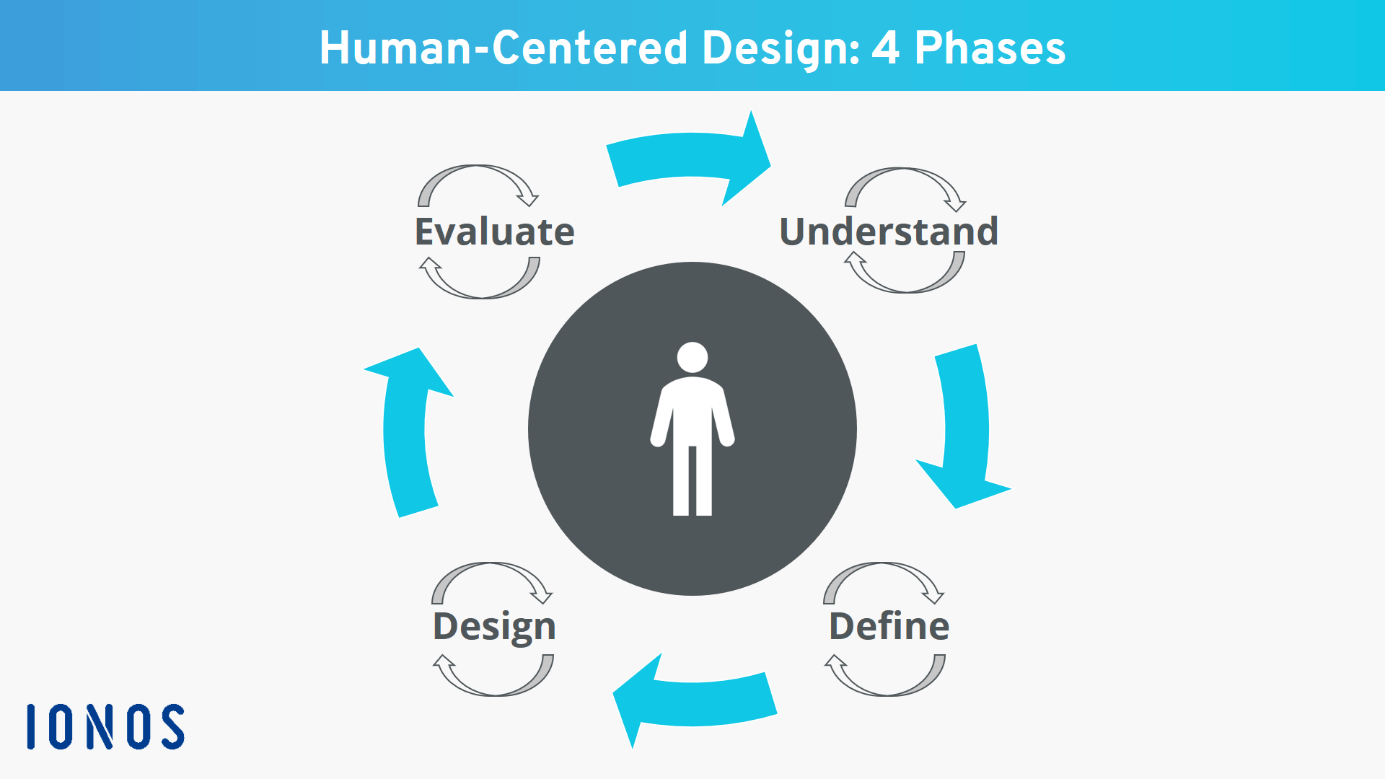
Human-centered design consists of four activities or phases that structure the development process:
- Understanding and describing the user context
- Defining the user requirements
- Drafting the design solutions
- Testing and evaluating the solutions
To examine the aspects that make up these phases let’s look at an example.
Case study: The human-centered design process in app development
Company ABC wants to develop a mobile app for a major corporation’s time-recording system. The mobile solution does not yet exist.
- Understanding and describing the user context: Before the project team starts developing the app, it will engage in discussion with the future users, in this case, the corporation’s employees. How has time recording been implemented to date? Which problems occurred? What do they want from a mobile application? Staff report that the web interface was used for clocking in and out on mobile devices, but navigation on a smartphone was awkward and resulted in frequent errors. Many employees admit that they’re not very tech-savvy and emphasize that a user-friendly design is their priority.
- Defining the user requirements: Besides the employees’ and managers’ specific wishes and requirements, budget and time constraints must be taken into consideration. For instance, the corporation wishes to retain its existing time recording system and supplement it with a mobile component.
- Drafting the design solutions: This is the state during which the actual prototyping process begins. The app interface is role-specific and recording time takes just three clicks. The functionality of the app has been reduced to include only the essential parts and ensure that less technically competent employees can use the app.
- Testing and evaluating the solutions: Initial mock-ups are submitted to a group of employees. They are asked for feedback, which is integrated into the ongoing development. At each development step, feedback is obtained until the final application is completed.
There can be iterations within individual phases. The methods used to tackle the human-centered design process are not prescribed. Companies can use the methods for field research, idea development and product tests that have proven themselves in practice.
Why it pays to focus on people
Human-centered design offers many advantages for companies and users. It can be used to develop both physical and digital products. The latter benefit particularly from the approach, as their success depends significantly on the interaction with users.
- Improved productivity: Developers can use their resources more effectively thanks to prompt feedback.
- Lower training costs: Applications created in a user-oriented process are intuitive, reducing support and training costs after publication.
- Competitive advantage: Using this approach, companies can respond to the actual needs of users and solve user problems more effectively than competitors who only test and improve finished products.
- High customer satisfaction: The process results in a better user experience. Few other methods produce results of similar quality.
- Less stress: Regular user feedback reduces the economic risk, making the working atmosphere more relaxed with a positive effect on the project team’s creativity. It also reduces user stress because the final product solves a specific problem and is easy to use.
Criticisms of human-centered design
Some critics say that the radical focus on user needs restricts developers' perspectives and prevents true technological innovation.
Similar arguments state that people’s lives and their challenges are changing rapidly, and any observations and surveys are useless if a product is not developed rapidly. Otherwise, the problems a product aims to solve will already have changed before its release.
Another criticism is the approach’s global perspective. Critics say it overemphasizes context and stakeholders, rendering it unsuitable for developing tailored solutions for a specific target group.
Relevance and outlook
The terms "user experience" and "usability" are ubiquitous in web design and development. Companies that develop their products in ivory towers are a dying breed. Human-centered design consistently incorporates the user focus in product development from start to finish.
Many companies using agile methods already follow a human-centered design approach, even if they don’t explicitly call it that. In the future, the question will not be whether user focus should be part of design and development processes, but how human-centered design can be implemented effectively in practice.
Reviewer

Melissa Senn
Melissa Senn has been with IONOS since 2016 and focuses on the areas of websites, e-commerce, social media, and AI in the Digital Guide. As a digital strategist, she draws on her extensive SEO and GEO experience to translate complex technological trends into practical content.