
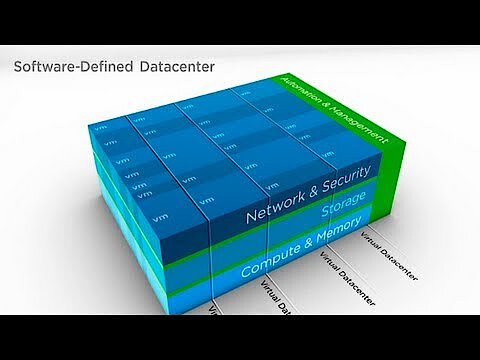
Software Defined Data Center (SDDC)

Cloud Computing is becoming more and more important for companies. Having your own hardware resources on site are a thing of the past, as are the associated costs, particularly high acquisition costs – the option of obtaining the required computing and storage capacities from a provider is very attractive.
Software Defined Data Centers, or SDDCs for short, are data center structures that consist of completely virtualized infrastructure and can be managed by software. IaaS providers use this concept to provide customers with a complete package of computing power, storage and network components such as switches or firewalls. The term “virtual data center” is also frequently used in this context.
Thanks to virtualized computing and storage power, as well as software defined networking, it is now even possible to rent complete data center structures: Providers no longer only provide storage and server performance, but also network components such as switches, load balancers or firewalls as virtual resources that can be conveniently controlled using software. It is therefore hardly surprising that not only providers but also an increasing number of experts see these Software Defined Data Centers (SDDCs) as the data center model of the future. The following sections explain why this is the case and how a software-controlled network works at all.
- Cost-effective vCPUs and powerful dedicated cores
- Flexibility with no minimum contract
- 24/7 expert support included
What is a Software Defined Data Center (SDDC)?
The software-defined virtualization and provision of computing power (software defined computing) and storage space (software defined storage) have long established themselves within the portfolio of cloud providers. For some time now, the future-oriented IaaS model, in which a higher-level software acts as a central control unit, has also been used for administrating network structures (software defined networking).
A software defined data center (SDDC) combines these three application-driven infrastructure services so that users can build their own customized data center. Using the appropriate software, typical components like routers, switches, servers load balancers or firewalls can be individually booked and organized in the virtual network without having to purchase their own hardware. Instead, it is provided by the IaaS provider, and they are also responsible for the maintenance and security of the devices. If certain components are no longer needed, they can be removed from the SDDC at any time. You can also add additional hardware to a software defined data center if larger structures are required.
 To display this video, third-party cookies are required. You can access and change your cookie settings here.
As with any software-defined Infrastructure-as-a-Service, a software defined data center does not necessarily have to be rented from an external vendor. Just like with a simple server or storage structures, it is of course also conceivable that with a virtualized data center, a company relies on an in-house solution and combines its own hardware to form an SDDC.
How do software defined data centers work?
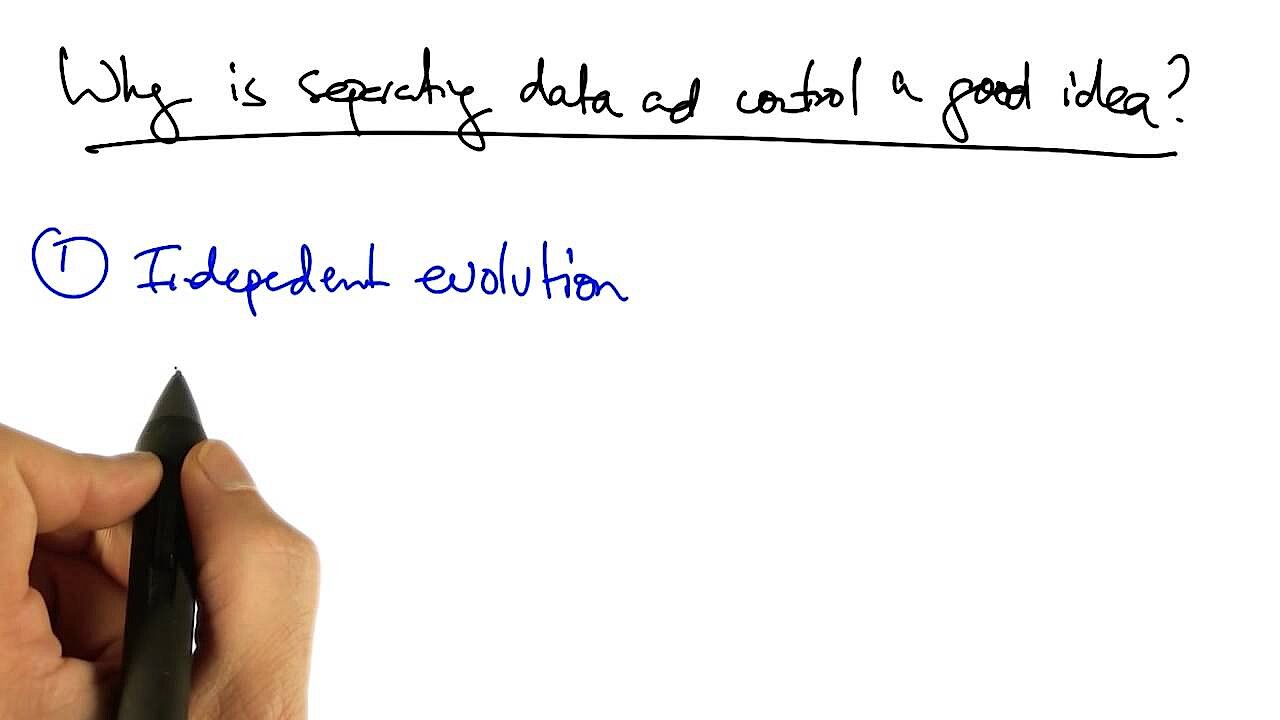
Just like any software-defined IT resource, the separation of control and data levels plays an important role in SDDCs: All control functions are abstracted in advance from the integrated hardware and implemented in higher-level software, which then functions as the control center (or “Control Plane”) of the virtual data center. It takes over all tasks that go beyond simple data processing at the data level (“Data Plane”) – for example, determining where an application or a certain process is executed, which path a data package should take, or exactly where files should be stored.
 To display this video, third-party cookies are required. You can access and change your cookie settings here.
Communication with the various devices works through standardized protocols like OpenFlow, BGP (Border Gateway Protocol) or NETCONF. These enable the control plane to uniformly control and expand the functions of the hardware components, regardless of which manufacturer they come from. In addition, it is not necessary to implement changes on each individual device, since the corresponding information can also be passed on centrally – with just a few clicks, or even automatically, through the software defined data center’s control software.
What are the challenges associated with an SDDC?
Software defined data centers make full use of virtualization technology, making administration a mammoth task. The virtual components and the underlying hardware must be formed into a unit that is still easy to oversee and manage. In particular, the fluid boundaries between real and virtual data centers present operators with major challenges: For example, it is necessary to perfectly harmonize the mediating tools between the virtual and physical environment. Otherwise, an error may be reported for a virtual component even though it originates at the physical level.
For further information about virtualization, please refer to our detailed article “What is virtualization?”: Definition and field of application.
The combination of the various software defined services (computing, storage, networking) is also more difficult than it might appear: The individual software-defined IaaS options are of varying maturity and have also established various protocols and interfaces, which must also be combined in the SDDC. This is also reflected in the hardware, which on the one hand must be easy to virtualize and on the other hand should support the interaction of various virtual server, storage and network components beyond its own hardware limits. This is the only way in which the software defined data center can guarantee the multi-client capable use of the infrastructure.
Client capable or client-suitable is information technology that can serve several clients (users) on the same server or software system. The different users who share the underlying hardware only have access to their own user administration and data.
What are the benefits and advantages of a software defined data center?
The goal of software-defined services is maximum flexibility, automation and efficiency. To achieve this goal, hardware dependency must be overcome and a maximum degree of virtualization must be achieved. The result is IT infrastructures without the physical limitations of traditional environments, which can be flexibly adapted to user requirements and scaled accordingly. After virtualized mass storage, server and network solutions, this approach is now being extended to a complete virtual data center in the form of the software defined data center, which has various advantages over the traditional data center with dedicated hardware:
- Simplified hardware management: SDDCs replace isolated hardware technologies and enable centralized management of all embedded components. This makes it easier for providers to build and deploy resources and for customers to control and monitor them. Companies also benefit from the fact that the purchase of their own hardware is completely eliminated.
- Lower costs: Software defined data centers are more cost effective than traditional data centers for two reasons. On the one hand, a large part of the hardware is cheaper due to the lack of control logic; on the other hand, simple scalability helps customers keep costs as low as possible.
- High planning reliability: By setting up or using a software-defined data center, you are well equipped for future technological developments. New functions can be integrated much more easily than in a traditional data center. The good scalability also allows selected resources to be increased or reduced at any time.
- High reliability: SDDC solutions are very fail-safe because the software-based architecture easily compensates for hardware failure. For this purpose, the corresponding workloads are transferred to other components within a very short time, without manual access to the failed devices being necessary.
- Increased security: In contrast to the traditional infrastructure of data centers, the SDDC model enables all security-relevant information to be bound to the virtual machines themselves. Security deficiencies, e.g. due to inadequate configurations, can therefore practically be ruled out.
- Less know-how required: Standardization, open protocols and manufacturer-independent programming means not just more flexibility, but also less dependence on specialist knowledge. The use of a software defined data center therefore makes it a large number of additional training courses and trained specialist personnel unnecessary.
What are the application scenarios for the SDDC model?
Software-defined services like a software defined data center are becoming increasingly important due to their great advantages over traditional infrastructure models. However, renting a complete data center is only a possibility for few companies. For this reason, IaaS providers’ SDDC offerings have so far mainly been aimed at enterprise customers who either want to supplement their own structures with virtual data center structures (hybrid solution) or want to replace them step by step. In the long term, the use of software-controlled storage, computing power and network components pays off in particular if the following scenarios are targeted:
- Optimization of your own data center: Those who already have their own data center take the next logical step with an SDDC – especially if software defined storage and software defined servers already play a role in the current structures.
- Dynamic connections: A software defined data center is perfect for establishing dynamic connections with individual bandwidth allocation and guaranteed Quality of Service (QoS) between different locations. In this way, different company locations (internal or partner) or used data centers can be connected efficiently.
- Optimal network access control: SDDC provides a centralized and convenient way to define permissions for all users and devices accessing an integrated network, including access control restrictions, service chain integration and appropriate quality of service.
- Automation of IT processes: Virtual data centers greatly simplify the work of administrators – especially through the high degree of automation of processes that are usually done manually. The software-defined approach is therefore a decisive factor in relieving the burden on existing IT personnel.
- Consolidation of classic cloud services: Traditional cloud services basically follow the same approach as software-based services by focusing on virtualization and policies. However, merging the services of different providers is often a major challenge that can be mastered with a software defined data center.
Conclusion: Infrastructure-as-a-Service driven to the top
Software Defined Data Centers combine all relevant IaaS offerings like storage, computing power and networks in virtual structures that replace a traditional data center one-to-one and can be controlled via a central software solution. Typical problems like complications when merging or expanding the functions of devices from different manufacturers or when increasing or decreasing resources are a thing of the past in a fully virtual data center. If the relevant hardware is even better equipped for use in the SDDC, enterprise companies will probably not be able to avoid this flexible and highly scalable technology in the future.
Reviewer

Christian Heldmaier
Christian Heldmaier is an experienced online marketing and SEO specialist from Karlsruhe. He has been working as an SEO Manager at IONOS since July 2020.