
What is OpenNebula and what are its use cases and advantages?

OpenNebula is an open-source cloud platform used to manage virtual data centers and cloud environments. It enables the orchestration of diverse resources and makes them available across different cloud models.
What is OpenNebula?
OpenNebula is an open-source toolkit for managing distributed IT infrastructures and is part of the Infrastructure as a Service (IaaS) category. It is designed for companies, research institutions, and service providers that want to run private, public, or hybrid cloud environments. The platform brings together storage, networking, virtualization, monitoring, and security technologies to provide virtual services and multi-tier applications.
OpenNebula supports widely used cloud standards and APIs, including Amazon EC2, which helps ensure interoperability and portability. By integrating different hypervisors such as KVM, VMware, LXD, and Firecracker, it can run on a broad range of hardware and software setups. This flexibility makes OpenNebula suitable for both traditional data center virtualization and modern cloud and container workloads. It can also be used in hybrid setups that combine on-premises infrastructure with public cloud services.
- Dedicated enterprise hardware
- Intel® Xeon® or AMD processors
- Leading security technologies
What are typical use cases for OpenNebula?
OpenNebula is used across a wide range of scenarios where infrastructure needs to be automated, efficient, and scalable. In short, it is a strong fit wherever centralized management of VMs or container environments is required.
Private clouds
OpenNebula is frequently used to build internal cloud environments. This allows IT teams to offer self-service portals where virtual machines or containers can be provisioned automatically at any time. These environments rely on local resources, ensuring that data sovereignty and control remain within the company’s own data center. Typical workloads for OpenNebula private clouds include development and testing environments, internal applications, and services that must remain outside public clouds due to security or compliance requirements.
Hybrid cloud scenarios
Another common use case is combining on-premises infrastructure with public cloud resources. OpenNebula can flexibly orchestrate workloads across local systems and external cloud services to handle peak demand or temporarily scale capacity. This enables companies to optimize costs while benefiting from cloud capabilities without fully migrating their infrastructure.
Edge computing and distributed infrastructures
OpenNebula can also be used to centrally manage resources in distributed environments with multiple smaller data centers, such as in edge computing. This approach reduces latency, which is especially beneficial for applications like IoT, distributed machine learning, or content delivery networks. Its lightweight architecture also makes OpenNebula a practical choice for smaller teams looking to avoid the complexity of large cloud platforms.
In addition, Kubernetes (K8s) is increasingly important as the standard for container orchestration in edge computing. OpenNebula supports modern Kubernetes workflows through native integrations such as the Cluster API Provider (CAPONE) and enables the deployment and management of Kubernetes clusters alongside traditional VMs, making the platform more versatile for hybrid and edge environments.
Architecture and deployment model
OpenNebula is based on a classic cluster architecture. A central front-end server (the master/controller) coordinates the system, while multiple hosts (the worker nodes) run the virtual machines. The following components are central:
- Front-end/master: This node hosts the OpenNebula services such as the management daemon (
oned), the scheduler (one_sched), and the web UI (“Sunstone”). It handles tasks like resource planning, job queuing, and provisioning VM images. - Hosts/worker nodes: These are physical machines with a supported hypervisor (e.g., KVM, VMware, LXD). They run the virtual machines or containers.
- Datastores: Datastores are storage areas for images, snapshots, and VM data. OpenNebula can use and manage various storage backends.
- Networks: Virtual networks are implemented using bridges, VLANs or SDN technologies and assigned to the VMs.
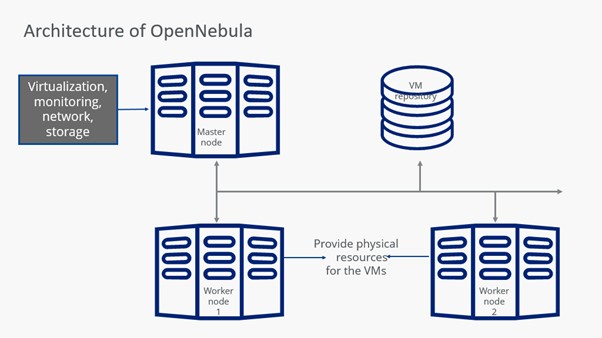
The components mentioned communicate via defined APIs and protocols. The model supports traditional VM workloads as well as container environments using technologies such as LXC/LXD or Firecracker for microVMs. In the comparison between OpenNebula vs. OpenStack, OpenNebula’s architecture is deliberately less modular, which lowers the entry barrier and operational complexity.
Advantages and disadvantages of OpenNebula
OpenNebula provides a comparatively lightweight entry point for building and running cloud infrastructures. Especially when compared to more complex cloud stacks, the focus is on ease of use, a clear architecture, and practical day-to-day operations. At the same time, this simplicity comes with certain functional limitations, which can become more relevant in very large or highly specialized cloud environments.
Key advantages include easy setup and lower operational overhead compared to platforms like OpenStack. OpenNebula requires fewer components, making it manageable even for smaller IT teams. It is particularly well suited for small to mid-sized private and hybrid clouds, where stability, transparency, and maintainability are prioritized over maximum scalability. Support for multiple hypervisors and cloud APIs improves workload portability and simplifies integration into existing infrastructures. OpenNebula also allows connections to public cloud resources, supporting hybrid operating models. The Sunstone web interface and CLI are considered intuitive, which helps keep onboarding time for administrators relatively short.
However, OpenNebula is less suited for extremely large or highly dynamic cloud environments. Scaling across very large clusters can be more limited compared to OpenStack. The platform is also less modular, so certain specialized features, as well as advanced networking and storage capabilities, are not available to the same extent. Its community ecosystem is smaller than that of other cloud platforms, which can impact the availability of extensions, integrations, and third-party tools. Additionally, some enterprise features are only available in commercial editions, which should be considered in long-term cost planning.
| Advantages | Disadvantages |
|---|---|
| ✓ Easy installation and manageable operational effort | ✗ Limited scalability for very large environments |
| ✓ Well suited for small and medium-sized clouds | ✗ Less modular |
| ✓ Support for many hypervisors and cloud APIs | ✗ Less functional depth in specialized areas |
| ✓ Suitable for hybrid cloud scenarios | ✗ Smaller community and plugin ecosystem |
| ✓ Intuitive web UI and CLI | ✗ Some enterprise features require a paid license |
| ✓ Short learning curve | ✗ Less widely used than solutions like OpenStack |
What are the alternatives to OpenNebula?
There are several other platforms in the cloud and virtualization space that may be relevant depending on your requirements:
OpenStack
OpenStack is probably the best-known open-source cloud stack and offers highly modular, scalable infrastructure services, including compute, storage, and networking. It has a large community and supports complex, highly available clouds. However, it is more complex to install and operate than OpenNebula, which is particularly noticeable for smaller teams.
Apache CloudStack
CloudStack is another open-source IaaS platform that orchestrates virtualization, networking, and storage. It focuses on ease of use and scalability and is commonly used in both public and private cloud environments. In the direct comparison on OpenNebula vs. CloudStack, CloudStack stands out due to its more active community, for example in terms of developer base and repository activity.
VMware Cloud Foundation
A commercial solution from VMware designed for deploying hybrid clouds with deep integration into the VMware ecosystem. It is well suited for companies that rely on VMware technologies and require comprehensive enterprise features and support. Due to licensing costs and overall complexity, it is primarily aimed at larger organizations.
Public Cloud IaaS (AWS, Azure, Google)
If running your own infrastructure is not a priority, public clouds such as AWS, Azure, or Google Compute Engine provide fully managed infrastructure services without the need for dedicated hardware. These solutions are highly scalable and offer a wide range of additional services, but they come with ongoing costs and dependencies on external providers.
Proxmox
In the comparison between OpenNebula and Proxmox, Proxmox is often cited as an alternative but follows a different approach. While OpenNebula is designed as a cloud management platform, Proxmox focuses on traditional server virtualization and cluster management for virtual machines and containers. Proxmox is therefore particularly well suited for small to mid-sized environments where virtualization, high availability, and straightforward administration are the main priorities.
Reviewer

Christian Heldmaier
Christian Heldmaier is an experienced online marketing and SEO specialist from Karlsruhe. He has been working as an SEO Manager at IONOS since July 2020.