

What is Twitter? Introduction: Twitter for business – Part 1

Twitter: a punchy name that reveals a great deal about the nature of the service. Founded in 2006, the company’s deliberately chosen name and its signature bird logo emphasizes the service’s main function; just as a tweeting bird’s call reaches everyone within earshot, so do Twitter users’ ‘tweets’ (text posts containing 140 characters or fewer) reach everyone within their online network. When compared to Facebook and other major social networks, communication over Twitter is less focused on maintaining contacts and sharing content with friends, and is instead far better suited to dispersing bulletins of information quickly. Tweets are designed to be read as quickly as possible, by as many people as possible. Twitter is therefore far better for communicating en-masse than directly to individual people. A tweet is simply a message or status posted on Twitter. The platform is also regarded as a public online journal or a micro-blogging service, as so many Twitter users primarily write about themselves and their personal experiences. Twitter grants users the opportunity to achieve a global outreach. But how can using Twitter help your business? To answer this, we can learn a lot from celebrities. By using Twitter to communicate directly with their fan base, public figures often gather an impressive number of followers. In fact, of the top 10 most-followed Twitter accounts, almost all are owned by celebrities. The only companies to feature on the list are giants, YouTube and Twitter itself (Source: Statista). Following the lead of celebrities, businesses can also enjoy a wide readership on Twitter. Tweets are an ideal way to communicate developments while enhancing the brand’s online presence, which in turn increases customer loyalty. But to succeed in this area, a coherent strategy is crucial. Read on to learn more about how to use Twitter for business, and what kind of Twitter tools are available for businesses.
Twitter tools at a glance
Twitter’s range of tools go far beyond just 140 character posts. A precise knowledge of these functions is essential for assessing Twitter’s potential value for businesses.
Tweets
Twitter’s primary means of communication is the tweet, a message that spans just a couple of lines. tweets are published on the author’s profile and a timeline for his or her followers to read. Tweets are public by default, so they are usually visible to unregistered readers. However, users can restrict access to their posts so that they appear only to select followers.
With Twitter, it’s easy to become a micro-blogger; all you need to do is create an account, write tweets, and steadily build up a follower base. You can also follow other accounts to read other people’s updates and participate in discussions. Twitter accounts can also be used to write private direct messages, although this function is used relatively seldom compared to tweets.
After 140 unicode characters, tweets are automatically cut off. The advantages of this characteristic trait have been hotly debated among users, but early plans to expand the character limit were scuppered after widespread opposition. Despite this, in November 2016, the rules did alter slightly; since then, attached photos and videos, citation, and mentions are not included in the word count. Unless their tweet contains a web link, in which case the characters are still counted, Twitter users can now use the 140 characters purely for content. If you’ve ever used Twitter yourself, you’ll know an extra couple of characters can make all the difference.
Links and attachments
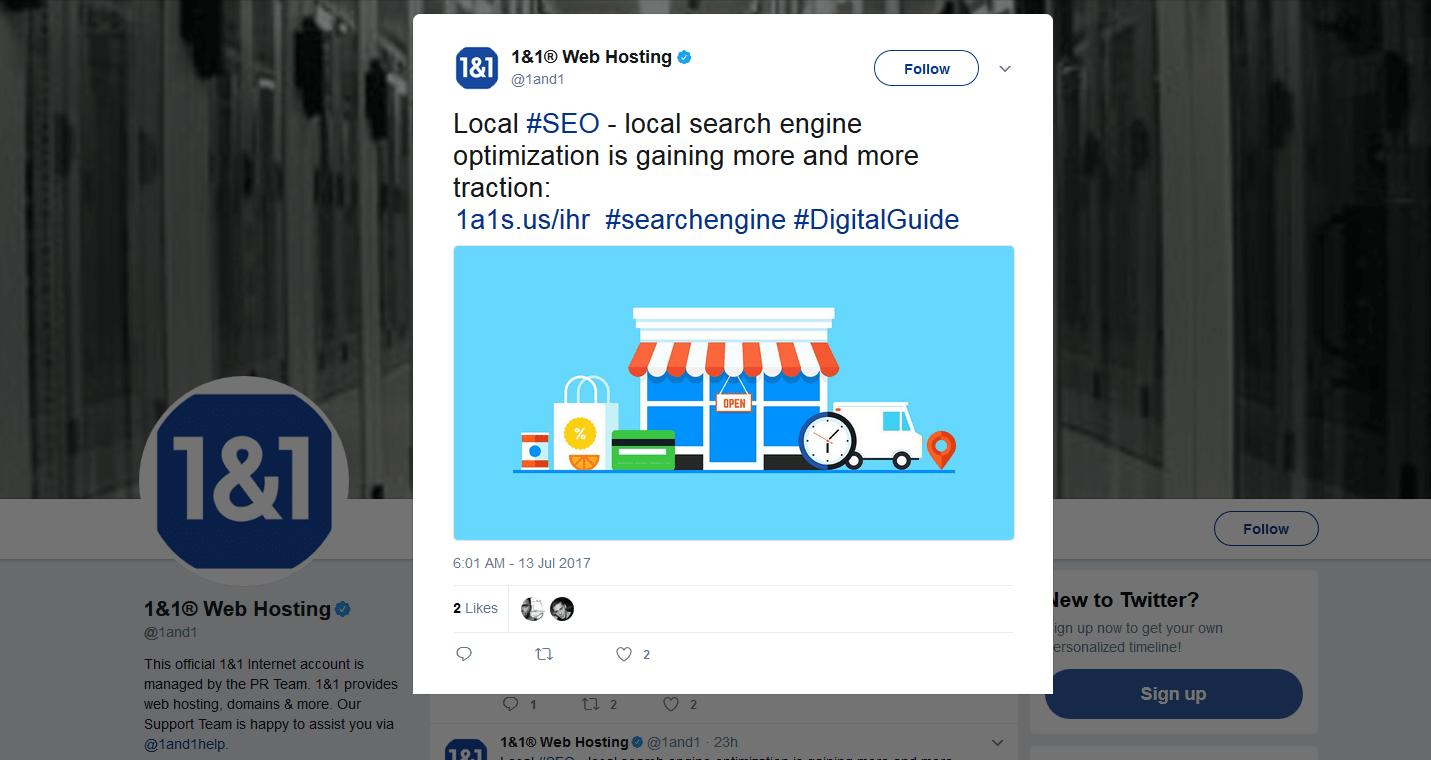
In addition to the text, a tweet can contain different kinds of links. These can be hashtags (words or phrases that begin with #), URLs, or links to other user profiles (beginning with the symbol @). Hashtags and links can be used to increase a tweet’s potential outreach. These are two of the most important Twitter tools for building up a large follower base. It’s also possible to attach media such as photos, videos, and citations of other tweets. Even though Twitter is not as well suited to images and videos as other social media platforms, adding media can be used for targeted social media marketing.
Timeline
Twitter users are able to follow accounts that are interesting or relevant to them. In doing this, they subscribe to that accounts tweets, which then appear in their personal timeline. This feed is updated in real time, so that users need never miss a tweet. From the timeline, users can read tweets from all the accounts they follow, as well as respond, retweet, and save the tweets to their favorites.
Reply, retweet, and favorite
There are three ways to respond to individual tweets, displayed as small icons beneath each tweet. From left to right, the different options are the reply function (symbolized with a small arrow pointing to the left), the retweet function (two arrows in a circle), or add to favorites (the heart). By replying to a tweet publicly, it’s possible to participate in lively conversations. Adding the tweet to your favorites (comparable to liking a post on Facebook) shows how popular a tweet was among readers and how many people it reached.
The retweet function allows users to share a tweet with their followers. Since 2016, users have also been able to retweet their own posts. Retweeting contributes significantly to expanding the outreach of a tweet, as followers can share interesting content with their own network in seconds.
The hashtag phenomenon
The hashtag is a type of keyword that has contributed to expanding Twitter’s outreach exponentially. Unlike retweeting, which just links to a specific user, a hashtag highlights and links a specific word or phrase and is then linked to a feed of tweets that use the same hashtag. For example, two of the most successful (i.e. the most clicked) hashtags in 2016 were #Election2016 and #RIP.
Benefits of social media marketing with Twitter
Twitter has drastically changed the way that businesses and the public interact with each other; communication is now much faster and more direct. This means it’s now possible for a business with any kind of budget to attract international attention and reach potential customers. Twitter has dedicated a section of its website to providing comprehensive information about tweeting for business. There is also a separate Twitter blog about marketing that is aimed at small businesses. In summary, there are four main aspects that make Twitter an interesting avenue for businesses to explore: with Twitter, it’s possible to
- follow current affairs and emerging trends in real time,
- increase brand awareness,
- offer a direct customer service, and
- build connections with potential customers and influencers.
Twitter prides itself on cultivating close relationships between businesses and consumers. This is possible thanks to its live update function, which allows companies to keep their finger on the pulse and quickly react to queries and comments. By following tweets in real time, the platform can also be used to assess the current mood. However, Twitter can be an unforgiving place at times – particularly for businesses that are still establishing their image. Because of the high outreach potential, you should always think carefully before you tweet to ensure you don’t harm your brand. But Twitter can also be an ideal place to learn from mistakes. Thanks to the constantly updating newsfeed, unsuccessful tweets will be quickly forgotten. Twitter is therefore a useful tool for gathering some early experiences in social media marketing. For those experienced in marketing, user reactions to your tweets are helpful for publishing exciting new offers, as well as trying out new concepts and developing innovative approaches to marketing.
How to set up a Twitter business account
Never forget: first impressions matter. Therefore, as a business, you can’t afford to neglect any area of your online presence. The following introduction to signing up your business on twitter provides a step-by-step demonstration of how to create an interesting Twitter account.
Registration and configuration
A Twitter account is quick and easy to set up; all you need is an e-mail address and a password, after which you can choose a username (which can also be changed at a later date), and you’re ready to go. Be careful with the username; it should be memorable, not too long, and have a clear reference to your company or brand.
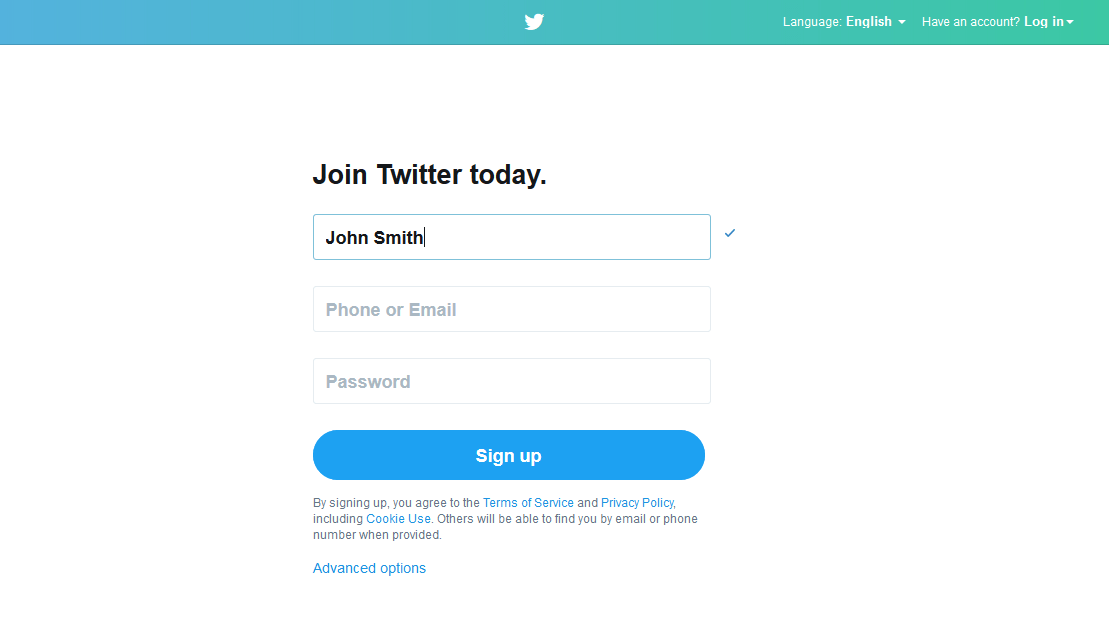
If you don’t want to set up your Twitter business page under your personal name, then the name (i.e. Example Inc.) and username (i.e. @Example_Inc) should be the same as the company name (i.e. Example Inc.).
New users will then automatically be led through several optional stages to complete the profile and build up a follower base. These include linking your Twitter to other sites and social media accounts, creating a timeline, and importing contacts from your e-mails.
The basic components of a Twitter account
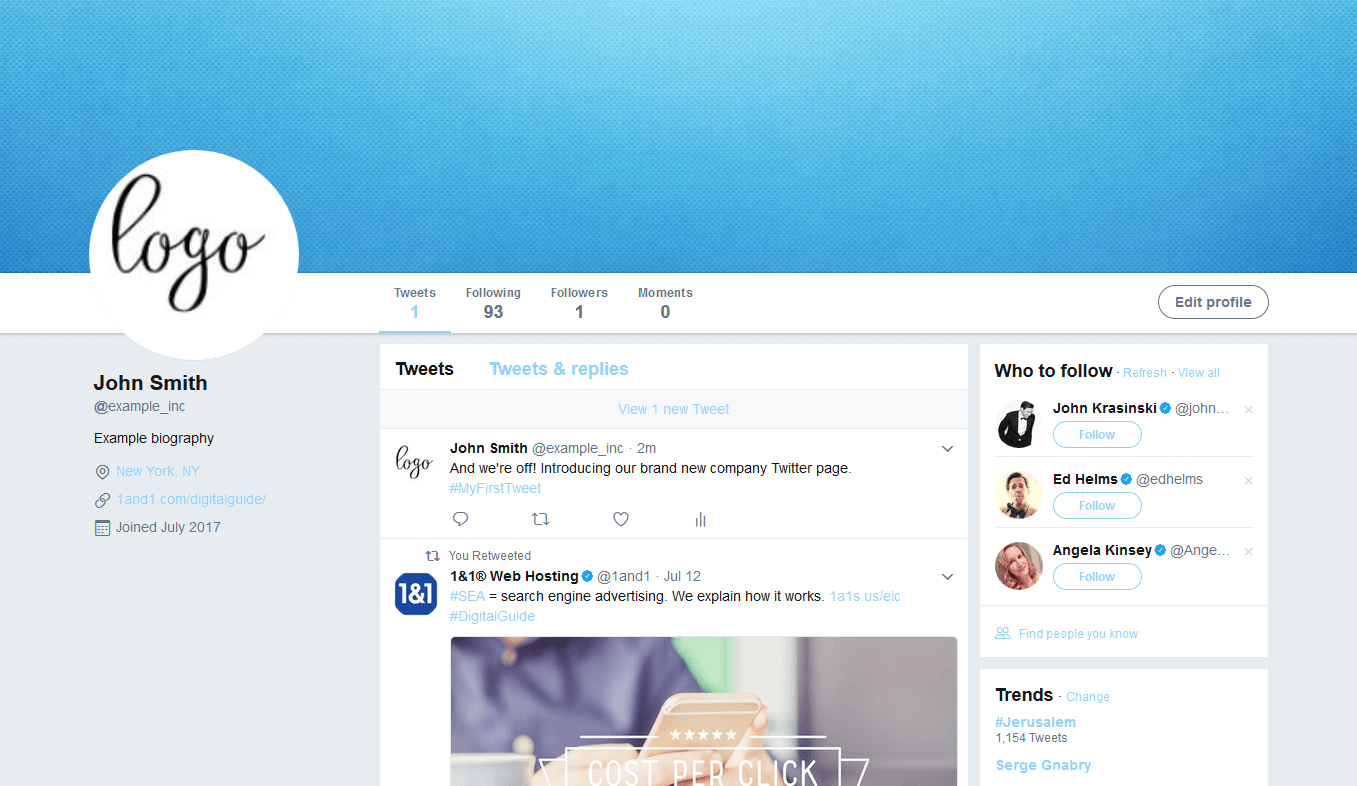
A Twitter profile is made up of six basic components: the profile picture, the header image, the design, the biography, location information, and a link to the company website.
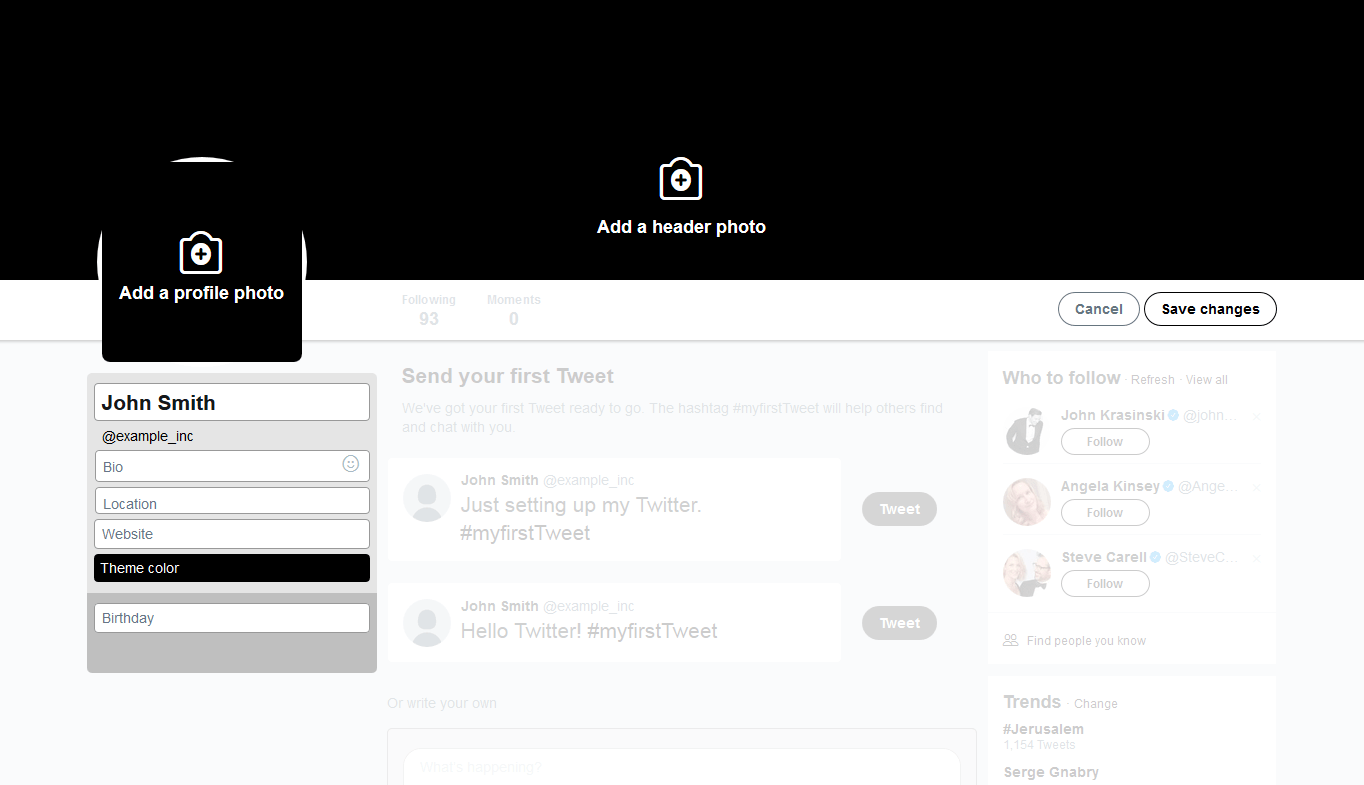
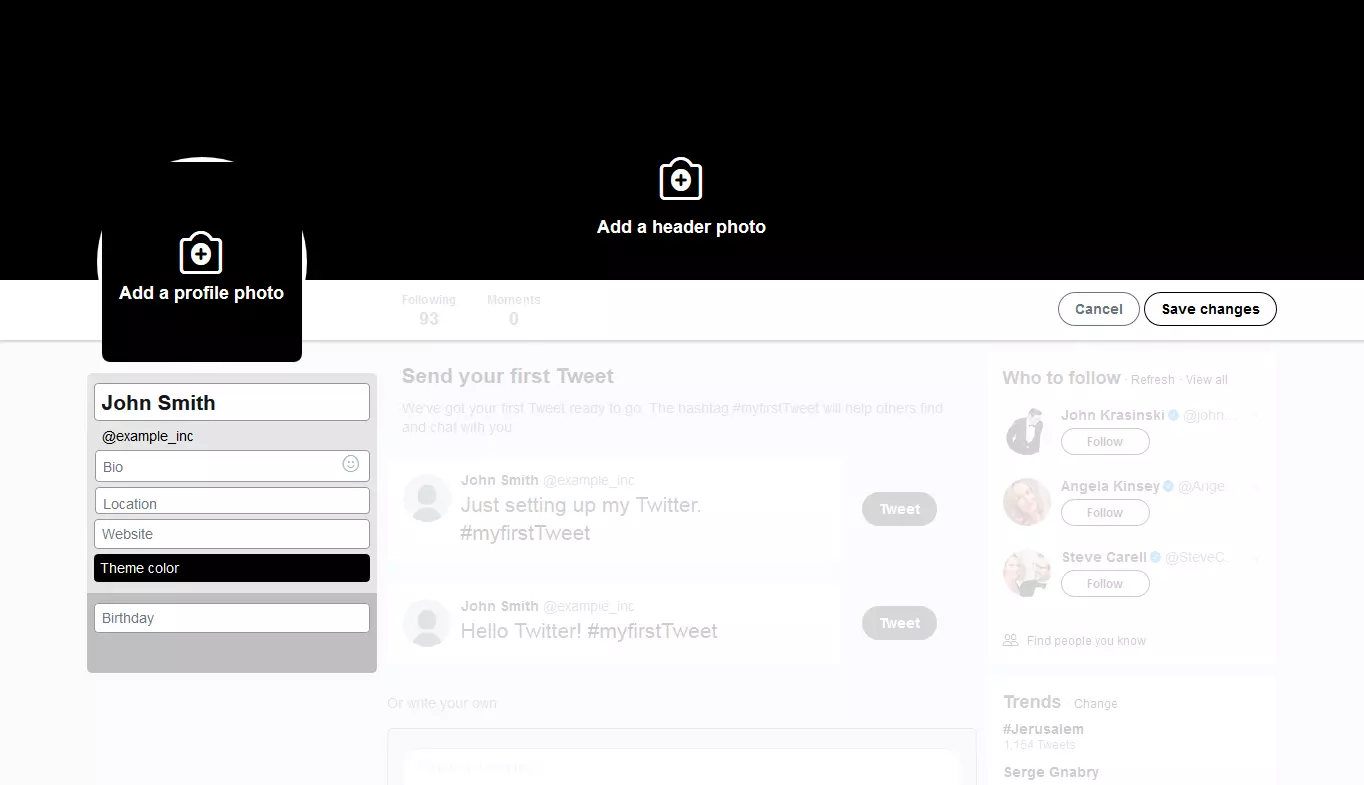
The profile picture is a crucial design element for any account. To appear professional and trustworthy, the image should represent the business in a simple and clear way. The company logo is ideal for this; however, it’s also worth considering a high-quality photograph of a company employee. After all, Twitter is a somewhat personal medium, and users tend to prefer to interact with a person rather than with a logo.
The header image is displayed in the upper area of the Twitter profile and can be used to convey a mood or further information. It’s better to use a simple and clear image, rather than a high-resolution photograph, which has too many distracting details. The chosen design should fit thematically and visually with the profile picture and the profile’s general image.
The biography area to the left of the timeline can be used as an extended kind of ‘business card’. As only 160 characters are available, the text should be short and only convey key information about your brand, goods, or services. You can also use this area for specific, brand-related hashtags or linking further company accounts. For example, the IONOS Twitter account offers a very concise biography with a link to its support team:
“This official IONOS Internet account is managed by the PR Team. IONOS provides web hosting, domains & more. Our Support Team is happy to assist you via @IONOS_help_US.” (Source: https://twitter.com/ionos_com)
You can also use the biography to include key promotional messages or any special achievements earned by your company, as well as information on what kind of content followers can expect from the account.
A full Twitter business account should also include the company’s location and a link to the website. This makes the company appear more professional and helps interested customers find further information about the business.
More settings and first activity
If you click on the smile profile picture icon in the upper right-hand corner of the menu, you can find further account settings. Among other things, you’ll be able to adjust your preferences on a range of information, including shipping information, orders, e-mail and online messaging options, and data privacy settings.
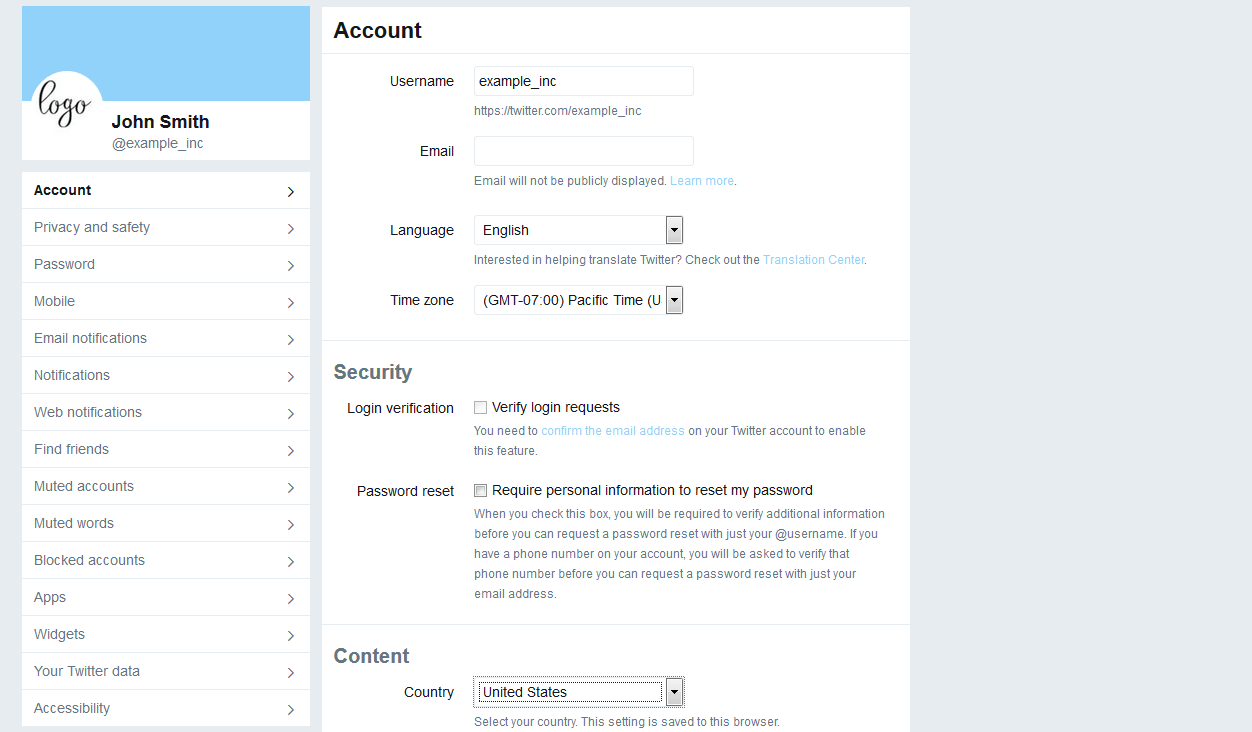
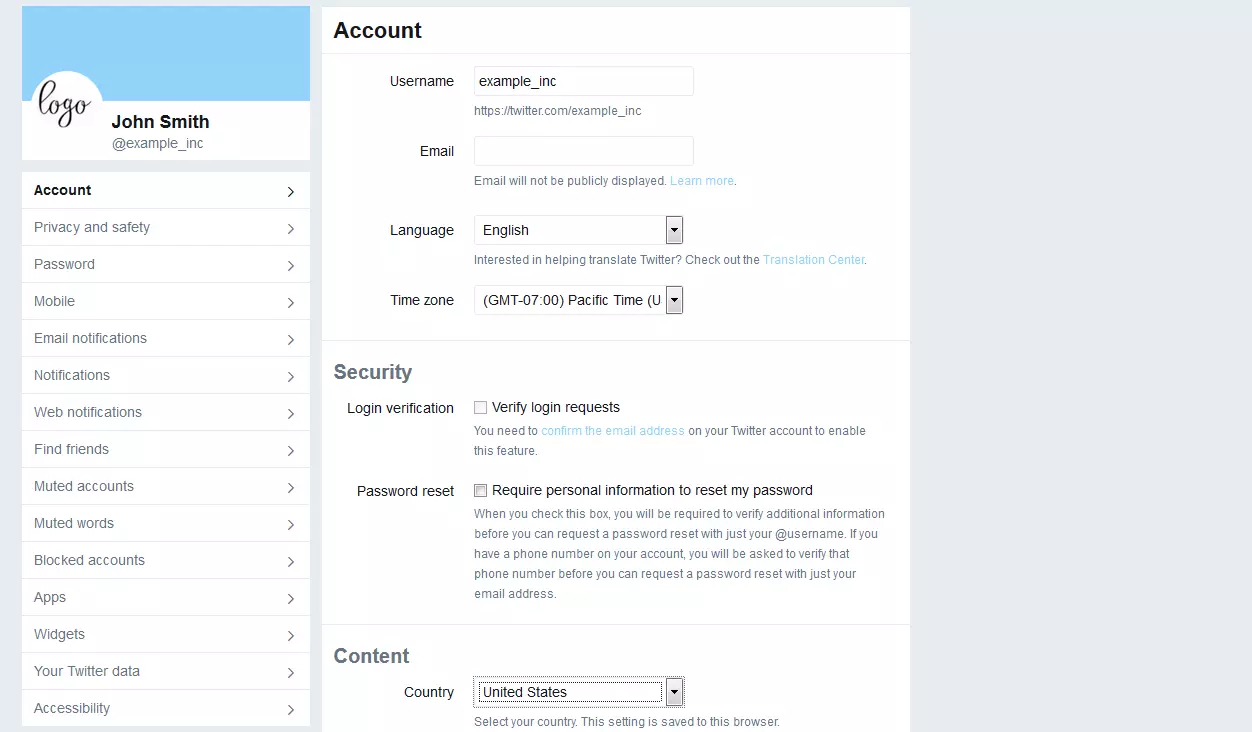
Now you’re ready to start tweeting! To compose a tweet, you simply need to click on the quill icon, which you can find in the upper right corner of the menu. Particularly important tweets can be pinned to the top of your feed, so that users see these first. This function can be found under ‘Options’ and then ‘More’.
How to use Twitter for businesses: strategy and methods
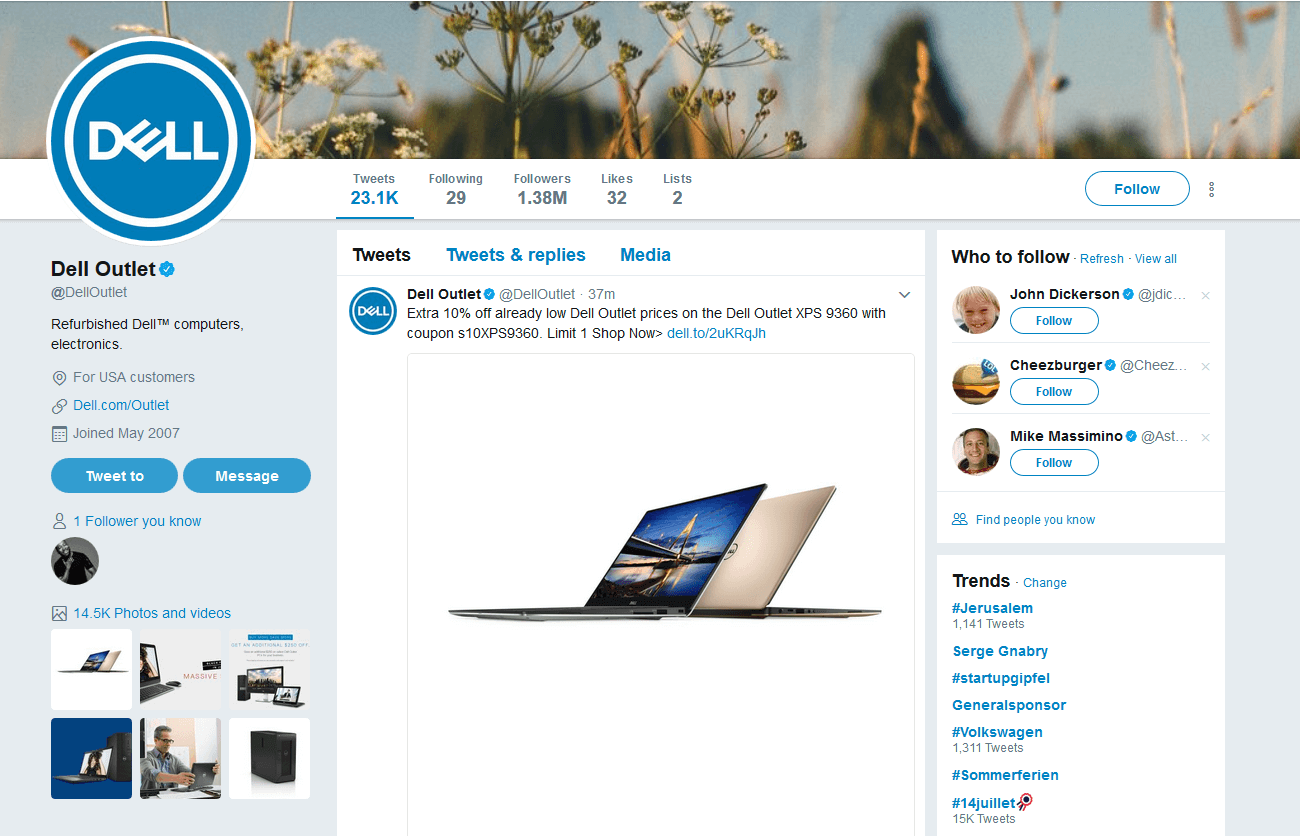
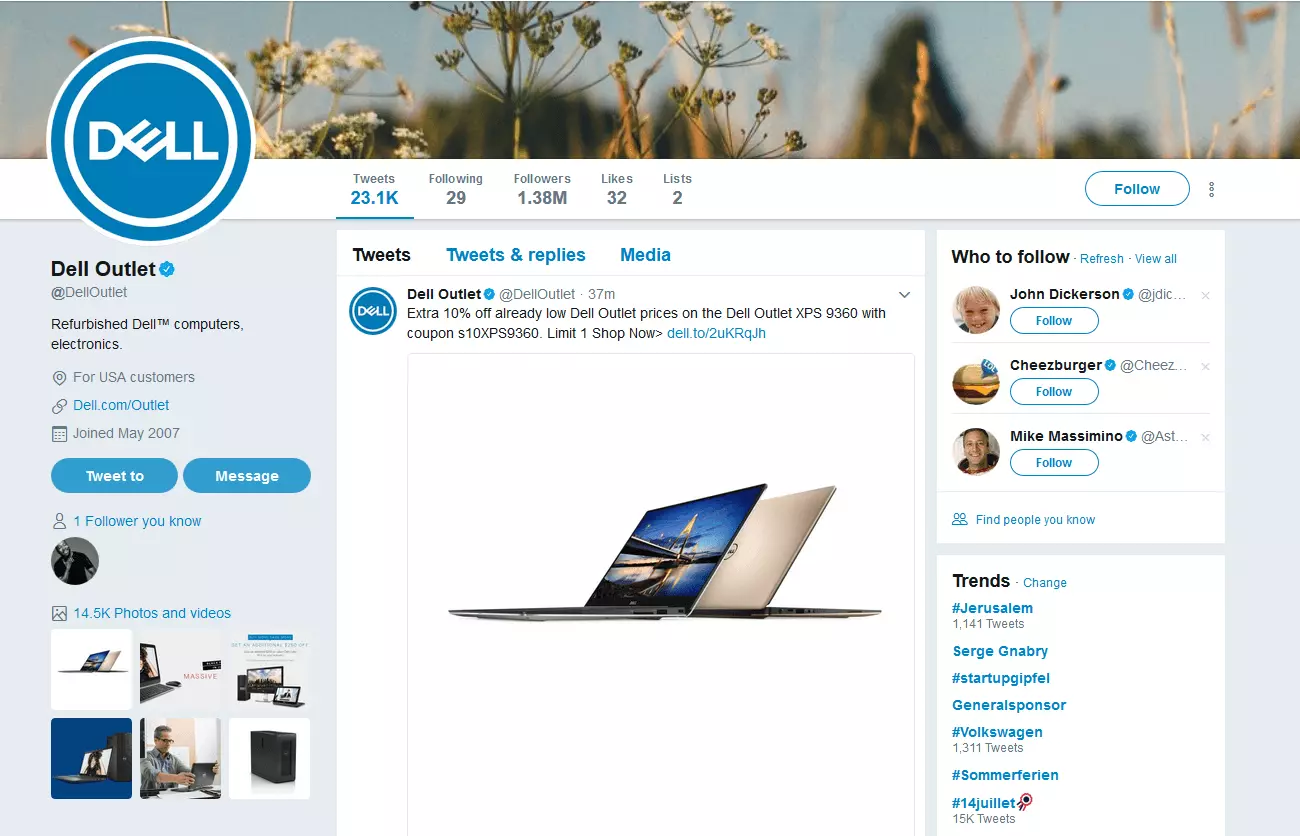
The technology company, DELL, is a prime example of optimal social media marketing with Twitter. Thanks to its 2007 marketing strategy, the company recorded sales of approximately $57 billion from Twitter alone. DELL operates with several different Twitter accounts worldwide, with its ‘DellOutlet’ account alone currently at 1.38 million followers.
To use Twitter for your business, you need to go much further than just setting up an account and writing some tweets. For your Twitter marketing campaign to be a success, goals, strategies, and methods should always be well thought-out. What follows is a guide with the most important tips for a successful Twitter company profile.
Setting clear goals
Developing a solid strategy is the basis of any successful marketing campaign. To start, you should be clear about the image you want to convey through your Twitter profile. Only when you’ve decided this can you coordinate other efforts, such as design, activity, and content, in a coherent manner.
A key element of an effective Twitter business strategy is the setting of concrete objectives. Twitter can be used to implement many different sales goals, however, what these should be depends very much on your company’s priorities. While one goal could be to attract new customers, you might prefer to use your Twitter to keep users up to date with news and special deals, retain existing customers, try out online trends, improve your general image, or increase brand awareness. It’s important to define a specific purpose for your Twitter account before composing any tweets.
While defining a target group is a crucial part of any strategy when setting up a Twitter business page, it’s also important to form a concept for the kinds of offers you’d like to achieve. Remember to ask yourself the fundamental questions: ‘Why?’, ‘Who?’, and ‘How?’ to make sure you’re clear about your aims, potential followers, and methods respectively. It’s advisable to write your strategy down in advance so that you can refer to it in the future and ensure that you stay on track.
Depending on the business and your chosen strategy, it could be a good idea to set up multiple accounts. If one account covers too many different offers or topics, this could also be viewed negatively by followers, as they want a coherent concept.
Building a follower base
The goal of social media marketing with Twitter is to make your profile visible to as many relevant accounts as possible. However, when it comes to followers, quality is more important than quantity. Instead of focusing on how many people respond to each tweet, look at how they respond. Do they actively engage with your tweets by replying or retweeting them? Does your follower base correspond with you target group? If your goods or services are aimed at teenagers, for example, how important are the followers who are over 50? Of course, for your Twitter marketing strategy to be as effective as possible, you ideally need a large number of followers that are relevant to your brand.
You should always write your first tweets before you start to follow any other accounts. Usually, when a user gains a new follower, they read the content on that profile. If they see that your account contains relevant and interesting tweets, they’re far more likely to follow this account back. Most users don’t normally bother to follow a blank account.
The most important and easiest way to grow your follower base is to follow accounts yourself. Just as personal Twitter accounts initially tend to follow people within their friendship circle, Twitter business accounts should first add business contacts and their followers. Personal networking is also an important part of growing your follower base. But, again, pay attention to quality! This is important because your company contacts are far more likely to follow you, rather than contacts that you have selected at random.
Twitter watches out for any highly imbalanced following-follower ratio to prevent users following thousands of accounts without having a few of their own. To follow more than 5000 accounts, you need to have over a certain number of followers yourself. Twitter’s support page elaborates:
“Every account can follow 5,000 users total. Once you’ve followed 5,000 users, there are limits to the number of additional users you can follow. This number is different for each account and is based on your ratio of followers to following; this ratio is not published. Follow limits cannot be lifted by Twitter and everyone is subject to limits, even high profile and API accounts.”
Twitter does this in an attempt to stop users from following accounts purely for publicity. The whole point of an interactive social media service is to interact with other users, and this must be respected for users to take advantage of Twitter’s full range of functions. You can find further information on Twitter’s guidelines on their support page.
Gaining a high number of valuable followers for your Twitter business page requires patience and dedication. It takes a great deal of time spent reading and understanding Twitter’s guidelines, as well as browsing, replying, tweeting, and searching for people in the industry. Successful Twitter accounts come about after sustained, active engagement – there’s no shortcut here. However, the effort pays off; in doing this, you remain up-to-date on current trends and developments in your industry. In this way, Twitter is great for businesses to find out potential customers’ areas of interest.
A large outreach, both online and offline, is a decisive factor in reaching a large number of followers quickly and organically. When writing tweets, remember to use hashtags and links! Another way to increase awareness of your business is to attract the attention of influencers and multipliers, as a retweet or mention from a popular page has a wide potential outreach. Don’t forget to promote your Twitter account outside of Twitter, i.e. on websites and other social media sites, in e-mail signatures, and on business cards.
For a new Twitter account to build up a loyal follower base, it takes time. But it’s truly worth the effort; quality followers ensure an effective social media marketing campaign. The initial effort pays off once an active follower base has been established, as the work becomes far less intensive.
You can find further tips on how to build a large follower base here.
Basic tips for successful tweeting
Strong tweets are, of course, one of the fundamental pillars of gaining more followers. But vague sentiments about ‘good’ activity and ‘the right’ tone don’t help businesses, who require a specific strategy for their own objectives. Needless to say, the brand, strategy, and Twitter account must be cohesive. But the type of content that works the best depends on the company: For some businesses, funny or entertaining tweets are the best way to attract attention, whereas in other sectors, humor could appear unprofessional, and concise, factual tweets are more appropriate. However, there are some fundamental aspects of Twitter relevant to all users:
Twitter is interactive
Tweets are a great way to announce exciting new developments within the company, but sometimes people forget that Twitter is also a platform for exchanges with consumers. This is crucial when using Twitter for business. Answering questions, initiating conversations, and participating in discussions are all important for customer retention and promoting the brand. Your interactions should be engaging and personal, and you should avoid generic comments at all costs. For example, instead of responding to someone with a bland comment such as, ‘Nice tweet,’ you should use the platform to share relevant links, peak your readers’ interest (‘Did you know...’) or ask users for their opinions (‘What do you think of...’). Always remember to link the users you are addressing (using the @ symbol). And don’t forget the golden rule of Twitter: good tweeting means participating in a dialogue.
Twitter is proactive
You can employ several different kinds of actions in order to motivate users to react to your tweets. These include, but are not limited to, live question-and-answer chat sessions, post from guest writers, creating a hashtag, or hosting a competition. Another efficient method is to use a survey or poll, as they actively invite followers to participate in your discussion, and this involves very little effort on the company’s side. These are the most common types of actions used by companies. See what works best for your company by experimenting with the kind of content at the frequency at which you post it. Whichever medium you choose to use, the bottom line is this: good tweeting means coming up with ideas to motivate users to interact with you.
If a business succeeds in creating its own hashtag and integrating it effectively into its marketing campaigns, it helps users to spread the word about your brand quickly, and may even ‘trend’ on Twitter. For example, the beverage company, Evian, had a particularly effective Twitter campaign for Valentine's Day. With the hashtag, #ILoveYouLike, the brand encouraged Twitter users to end the sentence and tag other users in their tweets. This sparked thousands of creative tweets from users all around the world, with the campaign quickly spreading to other social media platforms such as Facebook, Instagram, and Pinterest.
Twitter is personal
A personal tone often makes a faceless company appear my human, and therefore memorable. Especially when addressing customers, it’s important that the company’s voice is consistent with the brand’s image. But don’t forget that Twitter is ultimately a space for personal interactions, so the tone of your tweets should also be friendly and accessible. Make sure your tweets sound relaxed, rather than stiff. You can also help to create a more personal relationship with your followers with a light compliment or respectful retweet. You could even potentially use your Twitter business page to bring your followers together and strengthen the community surrounding your brand. Successful communication on Twitter should help spread positivity or useful information. Therefore, good tweeting also mean communicating positively.
Twitter's range of tools is minimal
Twitter doesn’t boast the same diverse range of functions as other social media platforms, so it’s important to master the few available options. This means using trending hashtags, retweeting, and tagging other users frequently. A retweet acts as a nod to the original author, and appears in that user’s notifications. Using hashtags is ideal for connecting your Twitter business account with current trends and topical debates, which presents the company itself in a current context. You can also take advantage of Twitter trends, such as the Follow Friday ritual (#ff), which involves recommending your favorite Twitter accounts. Good tweeting means using the limited Twitter tools perfectly.
You can also post images on Twitter
Although Twitter mostly relies on text-based posts, your social media marketing measures can also benefit from the use of images and videos. Users can attach multiple images to their tweets, and their followers can then browse through them. It’s also possible to upload videos without being included in the strict character limit. Good tweeting means practicing visual marketing.
Finding the right timing
Twitter feeds refresh continually in real time, so the timing of a tweet is incredibly important for reasons of visibility. No one wants their content to go unnoticed.
To ensure your tweets don’t get lost among the others, you should always publish your tweets at an appropriate time, ideally when the target group is most likely to be online. There are very few studies in this area, however, and depending on the target group, peaks in online traffic can vary wildly. In the world of business, however, tweets that are sent in the middle of the day (during the average lunch break) receive the most attention. Companies that operate internationally should remember to take account of time difference and other local factors, such as public holidays.
Furthermore, users appreciate it when businesses react to their comments as soon as possible. However, this can be hard to achieve for small businesses that may not have a marketing department working full-time on responding to customers’ messages. Fortunately, developers have created a range of tools that can help you organize your account and make this task more manageable. Posting frequently is also a big advantage. If you don’t post very often, the number of people reading your tweets will be drastically reduced. But it’s important that you don’t bombard your readers with a large influx of tweets either. After all, the quality of your tweets is what really matters, and high-quality means useful information. A constant stream of uninteresting content could irritate your readers, or even prompt them to unfollow you.


How to write the perfect tweet every time: keep it simple
To create a solid tweet every time, you should try to remember the following basic principle: the shorter, the better. Instead of trying to take up all 140 characters, it’s better to try and condense as much information into as few characters as possible. Keep it concise and to-the-point. A clear, precise message is far more effective for marketing purposes than trying to communicate several ideas at once. If you do want to provide further details, you can simply create a tweet with a link to your website or a blog post.
Hashtags, images, and videos can contribute additional visual appeal to your tweets, while embedding surveys, statistics, and links can express more information without overwhelming the reader. A personal tone helps users engage with their followers and form positive relationships. The final factor that can influence the impact of a tweet is its timing.
But what should you use your Twitter business page to say? Above all, quality content requires versatility and creativity, and your focus should always be to provide the kind of tweets that your followers would find valuable. If you want to communicate information, for example, your tweets can include news from your sector, developments within your company, press releases, specialist reports, or statistics and studies relevant to your business. Surveys on current topics also tend to be popular among users.
One way to build a more personal relationship with your followers or create a friendly and entertaining feel to your tweets is to share anecdotes from your workplace or the employee’s everyday life. You can also ask your followers how their day is going. On the other hand, if you want to use your business’ presence on Twitter to spark discussions, a call-to-action can be used to prompt an exchange. In order to do this, a company might end their tweet with ‘What do you think?’ or ‘Share your opinion!’
Learn about your target audience’s preferences
Informing yourself about your target group’s interests is particularly important for your Twitter strategy. To ensure your tweets are tailored to meet your target group’s specific needs, you need to be aware of the topics that interest these people and how you can reach out to them. To be able to assess your followers better, you can use surveys and continually check your followers’ activities and preferences. This can be done with the aid of evaluation tools. Find out more about these in the second part of our ‘Twitter for businesses’ series. The third and final part of this series deals with the topic of advertising on Twitter using the Twitter Ads platform.